
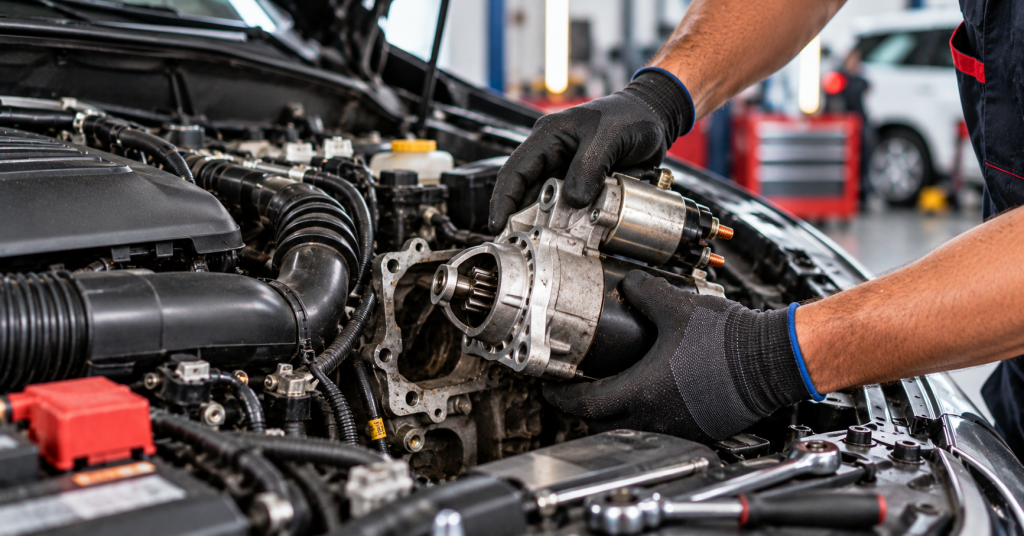
Starter motor repair Dubai may be needed when your engine will not crank, starts only intermittently, or makes clicking, grinding, or whirring noises during startup. However, a weak battery, poor electrical connection, faulty relay, or damaged wiring can create similar symptoms, so proper testing should come before starter replacement.
A starter motor has one demanding job: turn the engine fast enough for it to start. When the starting system develops a fault, you may suddenly find yourself with a car that has power but refuses to crank.
At Dubai Auto Repair, a no-start complaint should be diagnosed as a complete starting-system problem first. This guide covers seven starter motor warning signs, battery versus starter symptoms, testing, repair versus replacement, Dubai cost factors, and what to do when your car will not start.
Key Takeaways
- A car that will not crank does not automatically have a bad starter motor.
- A single click can indicate a starter, solenoid, cable, or connection problem.
- Rapid repeated clicking often points toward insufficient voltage or poor electrical connections.
- Grinding or free-spinning noises require prompt inspection.
- Battery condition should be checked before condemning the starter.
- Some starter components can be repaired, while severe internal damage may require replacement.
- Starter motor repair cost in Dubai depends heavily on vehicle design, parts, access, and the actual fault.
What Does a Starter Motor Do?
A starter motor is a high-torque electric motor that turns the engine during startup. When you turn the key or press the start button, the starting circuit activates the starter so the engine can begin running under its own power.
The battery supplies the electrical energy needed for this process. A starter solenoid helps engage the starter drive with the engine’s flywheel or flexplate. The starter then rotates the engine until combustion begins.
This entire process usually lasts only a few seconds, but it requires substantial electrical current. Battery condition, cable resistance, grounds, relays, switches, wiring, and the starter itself can therefore affect cranking.
That is why a no-start condition needs systematic diagnosis rather than an immediate starter replacement.
7 Signs You Need Starter Motor Repair
Common starter motor failure symptoms include clicking without cranking, intermittent starting, slow cranking, grinding, free-spinning noises, smoke or burning smells, and complete failure to crank. Each symptom provides a diagnostic clue, but none should replace proper testing.
1. One Click but No Cranking
You turn the key or press the start button and hear one solid click, but the engine does not turn.
This may happen when the solenoid activates but the starter motor cannot rotate. Worn solenoid contacts, internal starter damage, poor cables, or insufficient voltage can cause similar behaviour.
DENSO’s starter-system diagnostic guidance specifically recommends checking battery charge, cables, grounds, starter connections, and the control circuit when a starter clicks but does not crank.
A click is therefore useful evidence, but it is not a complete diagnosis.
2. Car Starts Sometimes
Intermittent starting is a frustrating early warning.
The car may start normally several times and then suddenly refuse to crank. After another attempt, it may work again.
Worn starter brushes, solenoid contacts, electrical connections, relays, or control-circuit faults can cause intermittent operation.
Do not wait until the vehicle stops starting completely.
3. Engine Cranks Slowly
A slow crank can sound like the engine is struggling to turn.
The starter may be worn or drawing abnormal current. However, a weak battery and excessive resistance in the battery cables can produce nearly identical symptoms.
This overlap matters in Dubai because replacing the starter will not fix a weak power supply.
If you are unsure whether the battery is involved, our guide to battery or alternator problems explains several electrical symptoms that commonly overlap.
Battery condition and voltage drop should be checked before the starter is blamed.
4. Grinding During Startup
Grinding during cranking needs attention.
The starter drive gear must engage correctly with the flywheel or flexplate. Worn starter-drive components or damaged gear teeth can cause abnormal engagement.
DENSO also recommends inspecting the flywheel or flexplate when starter engagement problems occur.
Repeated grinding can potentially increase mechanical damage. Do not repeatedly operate the starter simply to see whether the noise disappears.
5. Starter Spins but Engine Does Not
Sometimes you can hear an electric motor spinning, but the engine itself does not crank. This may indicate that the starter drive is failing to engage the flywheel or flexplate correctly.
A damaged overrunning clutch, starter drive, pinion gear, or flywheel teeth can be involved.
The sound is noticeably different from an engine cranking normally but failing to fire. That distinction matters because normal cranking with no combustion usually points away from the starter motor.
6. Burning Smell or Smoke
A burning smell during repeated starting attempts is a reason to stop. Electrical resistance, overheated cables, a stuck starter, or internal starter problems can generate excessive heat.
Repeatedly holding the ignition in the start position can make the situation worse.
Bosch technical guidance also identifies electrical and control faults among possible causes when a starter fails to disengage correctly.
If you see smoke or smell overheated electrical insulation, stop attempting to start the vehicle and arrange an inspection.
7. Nothing Happens When Starting
Complete silence can occur when you turn the key or press the start button. A failed starter is one possibility, but it is far from the only one.
Possible causes include:
- Discharged battery
- Loose battery connection
- Faulty starter relay
- Damaged wiring
- Starter solenoid fault
- Ignition or start-switch problem
- Immobiliser or control issue
- Faulty starter motor
A systematic electrical system diagnosis can narrow down where the start command or electrical supply is being lost.
Starter Motor or Battery?
A weak battery commonly causes slow cranking or repeated clicking, while a starter fault may cause a single click, intermittent no-crank condition, grinding, or failure despite adequate battery power. Symptoms overlap, so battery and starter-circuit testing provide a more reliable answer than sound alone.
Use this table only as a diagnostic starting point:
| Symptom | Battery More Likely | Starter More Likely |
|---|---|---|
| Rapid repeated clicking | ✓ | Possible |
| Slow cranking | ✓ | Possible |
| One click, no crank | Possible | ✓ |
| Grinding while starting | Less likely | ✓ |
| Starter spins, engine does not | — | ✓ |
| Intermittent no-crank | Possible | ✓ |
| Lights extremely weak | ✓ | Less likely |
| Battery tests healthy, no crank | Less likely | ✓ |
A corroded terminal or damaged ground cable can confuse this comparison. That is why proper car electrical repair in Dubai should address the circuit rather than replacing whichever component appears most obvious.
How Is a Starter Motor Tested?
Starter diagnosis should begin with the battery and electrical supply before testing the starter itself. A technician can inspect connections, measure voltage drop, verify the start signal, and test starter performance to identify whether the fault is inside the motor or elsewhere in the starting circuit.
A logical diagnostic process includes:
- Confirm the customer’s symptom. Note whether the car clicks, cranks slowly, grinds, spins freely, or remains silent.
- Inspect the battery. Confirm correct condition and state of charge.
- Check terminals and grounds. Loose or corroded connections can restrict starter current.
- Inspect starter cables. Look for physical damage, overheating, or excessive resistance.
- Check the control circuit. Confirm that the starter receives the correct start command.
- Perform voltage-drop testing. Excessive resistance can prevent full current from reaching the starter.
- Test starter operation. Further testing can identify an internal starter or solenoid problem.
- Inspect engagement components when needed. Grinding or free-spinning may require checking the pinion and flywheel or flexplate.
DENSO’s starter-system diagnosis guidance recommends beginning with a fully charged battery and clean, secure battery, ground, starter-motor, and solenoid connections.
That sequence prevents unnecessary starter replacement. It also explains why swapping parts without testing can become expensive.
Starter Repair vs Replacement
Starter motor repair can make sense when a serviceable component has failed and the rest of the unit remains in good condition. Replacement may be more practical when the motor has extensive internal wear, several components are damaged, or repair costs approach the price of a reliable replacement unit.
Starter assemblies contain several components that may wear or fail, including:
- Brushes
- Solenoid
- Electrical contacts
- Armature
- Commutator
- Bearings or bushings
- Starter drive
- Pinion gear
- Internal wiring
Not every problem requires a complete new starter.
For example, some starter designs allow a failed solenoid to be serviced separately. DENSO notes that a defective solenoid may sometimes be replaceable independently when testing confirms that specific fault.
However, repairability varies by starter design and parts availability.
Can You Drive With a Bad Starter?
A failing starter normally affects starting rather than normal engine operation after the vehicle is running. However, if you switch the engine off, it may not start again, so an intermittent starter fault can still leave you stranded without warning.
This differs from a failing alternator. The alternator supplies electrical power while the engine runs. The starter’s main job happens during cranking.
If your vehicle becomes stranded, follow the safe steps in our car breakdown in Dubai guide rather than repeatedly trying to crank it.
Why Starter Motors Fail in Dubai
Starter motors wear because each engine start places electrical and mechanical load on the system. Dubai’s high temperatures can add thermal stress, while frequent short journeys and repeated engine starts increase the number of starter operating cycles.
Heat should not automatically be blamed for every failure. Age, mileage, electrical resistance, contamination, component quality, and starting frequency all matter.
Common starter-related failure causes include:
- Worn brushes
- Worn solenoid contacts
- Damaged starter drive
- Internal electrical faults
- Poor battery connections
- High resistance in cables
- Weak grounds
- Damaged pinion teeth
- Flywheel or flexplate damage
- Excessive repeated cranking
Our guide to car wiring repair explains why damaged cables, connections, and wiring should be tested rather than overlooked.
What If the Engine Cranks Normally?
If the starter turns the engine at normal speed but the engine does not start, the starter motor is usually doing its primary job. The fault may instead involve fuel delivery, ignition, engine management, sensors, immobiliser systems, or another mechanical or electrical problem.
This distinction can save unnecessary repair costs. Listen carefully to what happens when you try to start the vehicle.
“No start” and “no crank” describe two different problems.
No crank: The engine does not physically turn when you request a start.
Crank but no start: The engine rotates normally but does not begin running.
Starter motor repair primarily addresses the first situation. If the engine cranks normally, broader diagnostics may be necessary.
How to Reduce Starter Problems
You cannot prevent normal starter wear indefinitely, but maintaining the battery and electrical connections can reduce unnecessary strain on the starting system. Investigating slow or intermittent cranking early can also prevent a minor issue from becoming a complete no-start condition.
Useful habits include:
- Keep the battery in good condition.
- Maintain clean, secure battery terminals.
- Investigate slow cranking early.
- Repair damaged grounds and cables.
- Avoid unnecessary repeated cranking.
- Do not ignore grinding noises.
- Diagnose intermittent starting before complete failure.
- Use correctly specified replacement parts.
Our car battery life in Dubai guide explains how local conditions can affect battery performance and replacement planning. Routine inspections can also catch other problems before they cause a breakdown. See our car maintenance tips for Dubai for a broader maintenance checklist.
When to Book Starter Motor Repair
Book starter motor repair in Dubai when your vehicle develops repeated no-crank problems, a single click with no start, grinding during startup, intermittent starting, or confirmed starter-circuit faults. Diagnosis should verify battery condition and electrical supply before a starter motor is repaired or replaced.
At Dubai Auto Repair, electrical diagnosis can help separate starter faults from battery, wiring, cable, relay, and charging-system problems.
If the vehicle will not start where it is parked, our guide comparing a mobile mechanic vs garage in Dubai can help explain when on-site diagnosis may be practical.
Frequently Asked Questions
Q1: What are the signs of a bad starter motor?
Common bad starter symptoms include a single click without cranking, intermittent no-start problems, slow cranking, grinding, a starter that spins without turning the engine, and complete no-crank failure. Battery and cable problems can imitate several of these symptoms, so testing is important.
Q2: How much does starter motor repair cost in Dubai?
Starter motor repair cost in Dubai varies by vehicle, starter design, fault, labour, accessibility, and parts choice. Repairing a serviceable component can cost differently from replacing the complete starter, so an accurate quote requires diagnosis and vehicle details first.
Q3: Why does my car click but not start?
A click with no cranking can occur when the starter solenoid operates but the starter cannot turn, or when insufficient voltage reaches the starter. Battery condition, terminals, grounds, cables, control wiring, solenoid contacts, and the starter motor should be checked.
Q4: Can a bad battery look like a bad starter?
Yes. A weak battery can cause slow cranking, clicking, or complete failure to crank, which can resemble starter motor failure. Battery state of charge, battery performance, terminals, and cables should therefore be checked before replacing the starter.
Q5: Can a starter motor be repaired?
Some starter motors can be repaired when serviceable components such as the solenoid, brushes, contacts, bearings, or bushings fail. Replacement may be more practical when internal damage is extensive, multiple components have failed, or repair becomes uneconomical.
Q6: Can a bad starter drain the battery?
Repeated attempts to operate a faulty starter can consume significant battery energy and leave the battery discharged. However, a battery that becomes flat while the vehicle is parked may have a different electrical drain, battery, or charging-system problem. If the battery repeatedly goes flat after parking, see our guide to car battery drain causes.
Q7: Why does my starter grind?
Grinding during startup can indicate improper engagement between the starter pinion and the flywheel or flexplate. Worn starter-drive components or damaged gear teeth may be responsible, so repeated grinding should be inspected rather than ignored.
Final Thoughts
Starter motor repair Dubai should begin with a complete starting-system diagnosis. Clicking, slow cranking, intermittent starting, grinding, free-spinning, smoke, and no-crank conditions can indicate starter trouble, but batteries, cables, grounds, relays, and wiring can create similar symptoms.
Testing the battery and electrical supply first helps prevent unnecessary starter replacement. Once the fault is confirmed, the condition of the starter determines whether repair or complete replacement makes more sense.
If your vehicle is becoming difficult to start or has stopped cranking completely, Get in touch with Dubai Auto Repair for starting-system and electrical diagnosis. Finding the actual fault first can save unnecessary parts replacement and reduce the chance of being stranded by a no-start problem.

