
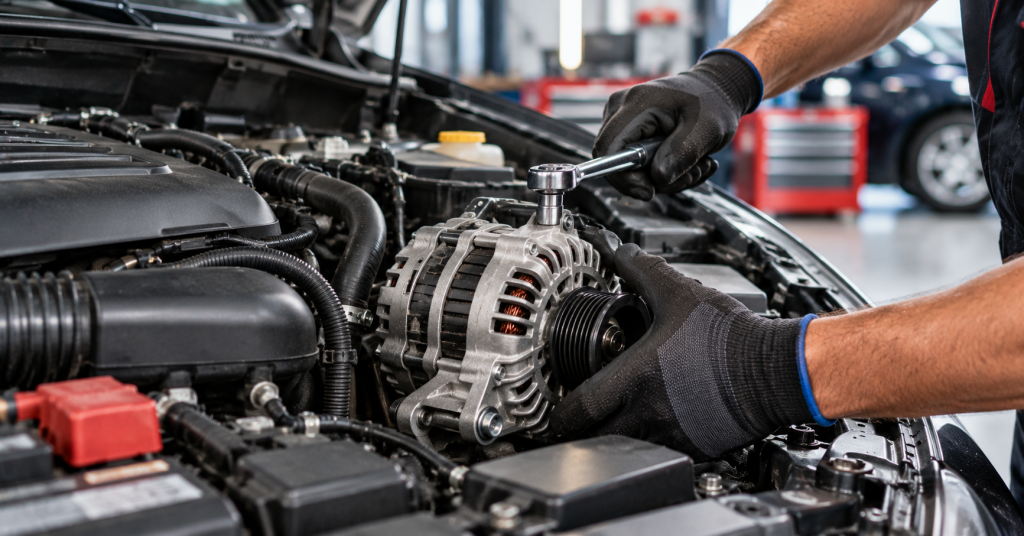
Car alternator repair Dubai becomes necessary when the alternator cannot properly charge the battery or power electrical systems while driving. Common warning signs include a battery light, dim headlights, repeated flat batteries, electrical faults, unusual noises, and engine stalling. A charging-system test can confirm the actual cause before repair.
Dubai’s heat and demanding driving conditions can put extra stress on batteries, belts, wiring, and electrical components. However, these symptoms do not always mean the alternator itself has failed.
At Dubai Auto Repair, charging problems should be diagnosed before replacing expensive components. This guide explains seven common alternator warning signs, diagnosis, repair versus replacement, Dubai cost factors, and when you should stop driving.
Key Takeaways
- A battery warning light can indicate a charging-system fault, not just a bad battery.
- Repeated flat batteries may result from alternator, battery, wiring, or parasitic drain problems.
- Many conventional 12-volt charging systems operate around 13.5–14.5 volts while running.
- A damaged belt or poor electrical connection can imitate alternator failure.
- Some alternators can be repaired, while severe internal damage may require replacement.
- Proper diagnosis should come before buying a battery or alternator.
- Driving with a failing alternator can eventually cause the engine to stall.
What Does a Car Alternator Do?
A car alternator generates electrical power while the engine runs. It supplies electricity to vehicle systems and replenishes the energy the battery used to start the engine.
The alternator produces alternating current. Rectifier diodes convert that electricity into direct current, while a voltage regulator controls charging output.
According to AAA’s explanation of vehicle charging systems, a typical system involves power generation, rectification, voltage regulation, electrical distribution, and battery recharging.
Many conventional charging systems operate around 13.5–14.5 volts while the engine runs. However, exact specifications vary between vehicles.
The battery and alternator therefore perform different jobs. The battery provides substantial power during starting, while the charging system supports electrical demand and restores battery charge afterward.
If the alternator stops charging correctly, installing another battery may only provide temporary relief.
7 Signs You Need Alternator Repair
Common signs of alternator trouble include a charging warning light, dim lights, repeated battery discharge, unstable electronics, unusual noises, burning smells, and engine stalling. Because several faults can produce these symptoms, testing should confirm the cause.
1. Battery Warning Light Appears
The battery-shaped dashboard warning does not automatically mean your battery has failed.
It generally indicates a problem within the charging system. The alternator is one possible cause, but the voltage regulator, belt, cables, or connections may also be responsible.
If the warning remains illuminated while driving, arrange an inspection soon.
2. Headlights Dim or Flicker
An alternator that cannot maintain stable output may affect vehicle lighting.
Headlights may become noticeably dim. Interior lights can also fluctuate when the AC blower, cooling fan, or other electrical equipment operates.
However, damaged wiring and poor connections can cause similar symptoms.
Dubai Auto Repair’s guide to car electrical repair in Dubai explains other common electrical faults that can affect vehicle systems.
3. Battery Keeps Going Flat
A battery that repeatedly loses charge is an important warning sign.
The battery can be perfectly serviceable but still become discharged when the alternator fails to replace energy consumed during driving.
However, an alternator is not the only possible cause. Accessories or electrical modules may continue drawing power after the engine switches off.
Read our guide to common car battery drain causes if your battery repeatedly becomes flat after parking.
Testing both battery condition and charging output prevents unnecessary replacement.
4. Electrical Systems Behave Strangely
Modern vehicles depend heavily on stable voltage.
You may notice slow electric windows, dashboard flickering, infotainment restarts, weak lighting, or multiple warning messages appearing together.
These symptoms can appear unrelated. However, unstable system voltage may affect several electronic modules simultaneously.
That is why proper electrical system diagnostics should test the power supply before individual electronic components are blamed.
5. You Hear Whining or Grinding
A failing alternator can sometimes produce unusual noises.
Worn bearings may create grinding or growling sounds. Belt, pulley, or tensioner problems can create squealing or whining noises.
Noise alone does not prove alternator failure.
A technician should identify the source before replacing the alternator.
6. You Notice a Burning Smell
A slipping belt may generate heat and create a rubber-like smell.
Damaged wiring, excessive electrical resistance, or overheated alternator components can also produce unusual odours.
Do not ignore a persistent burning smell.
Electrical overheating can damage wiring and surrounding components if the underlying fault continues.
7. The Engine Stalls While Driving
Severe charging failure can eventually stop the vehicle.
When alternator output disappears, the vehicle may continue running temporarily using stored battery energy. Once battery voltage falls too low, essential electrical and engine-management systems may stop operating.
The exact distance cannot be predicted safely.
If the charging warning appears alongside rapidly weakening electrical systems, move somewhere safe while the vehicle still operates.
Battery or Alternator: Which Is Bad?
Battery problems commonly become noticeable when starting the engine, while alternator faults often continue or become clearer after the engine starts. However, both components can create similar symptoms, so battery condition and charging output should be tested before replacement.
Use this comparison as a starting point:
| Symptom | Battery More Likely | Alternator More Likely |
|---|---|---|
| Slow engine crank | ✓ | Possible |
| Clicking during startup | ✓ | Possible |
| Battery warning while driving | Possible | ✓ |
| Lights weaken while driving | Possible | ✓ |
| New battery repeatedly goes flat | Possible | ✓ |
| Electrical faults while driving | Possible | ✓ |
| Engine stalls after starting | Less likely | ✓ |
| Abnormal charging output | — | ✓ |
This table cannot replace diagnosis.
A loose battery terminal, damaged charging cable, slipping belt, or electrical drain can blur the distinction.
Our detailed battery or alternator problem guide explains how these two failures differ.
How Is an Alternator Tested?
Alternator testing should assess the battery, charging voltage, electrical load, drive belt, cables, and connections. Measuring voltage can identify abnormal charging, while further tests determine whether the alternator or another charging-system component caused it.
A professional diagnostic process may include:
- Inspect the battery and terminals. Check battery condition, connections, and visible corrosion.
- Inspect the drive belt. Look for excessive wear, looseness, damage, or slipping.
- Check battery voltage. Measure the battery before starting the engine.
- Measure running voltage. Compare charging voltage with manufacturer specifications.
- Apply electrical load. Switch on major electrical consumers and monitor system performance.
- Check voltage drop. Excessive cable resistance can reduce effective charging.
- Test alternator output. Further testing can identify regulator, diode, or internal faults.
DENSO’s charging-system diagnostic guidance notes that technicians should inspect connections and charging-system components instead of relying on one voltage measurement.
Therefore, a single universal voltage number should never override manufacturer specifications.
Alternator Repair vs Replacement
Alternator repair may be worthwhile when a serviceable internal component has failed and the remaining unit is healthy. Replacement often makes more sense when several components are damaged, internal windings fail, or repair costs approach the price of a dependable replacement.
Alternators contain several components that can develop faults:
- Bearings
- Brushes
- Voltage regulator
- Rectifier diodes
- Rotor
- Stator
- Pulley
- Electrical connections
For example, worn bearings do not always require replacing every alternator component.
However, rebuilding a heavily worn unit may create false economy. Another internal component could fail shortly afterwards.
Should You Repair or Replace?
| Alternator Condition | Repair May Suit | Replacement May Suit |
|---|---|---|
| Serviceable regulator fault | ✓ | |
| Replaceable bearing failure | ✓ | |
| Worn serviceable brushes | ✓ | |
| Severe winding damage | ✓ | |
| Multiple internal failures | ✓ | |
| Extensive heat damage | ✓ | |
| Repair near replacement cost | ✓ | |
| Severely worn older unit | ✓ |
The correct decision depends on alternator condition, vehicle design, replacement quality, and parts availability.
Ask what failed before approving a complete replacement.
Car Alternator Repair Dubai Cost
Car alternator repair Dubai costs vary because repairing a minor internal component is very different from installing a complete alternator. Vehicle make, alternator type, accessibility, labour, parts quality, and related electrical faults all influence the final price.
Therefore, a universal price can be misleading.
Important cost factors include:
- Vehicle make and model
- Alternator design and output
- Alternator location
- Labour required for removal
- Genuine, OEM-quality, rebuilt, or aftermarket parts
- Voltage regulator condition
- Belt and tensioner condition
- Wiring or connector damage
- Additional charging-system faults
Luxury and performance vehicles may also use more complex charging systems. Access to the alternator can require removing additional components.
This approach can also prevent unnecessary expenses. Replacing an alternator will not solve the problem if excessive cable resistance prevents charging current from reaching the battery.
Can You Drive With a Bad Alternator?
Driving with a confirmed failing alternator is risky because the vehicle can lose electrical power and eventually stall. If the charging warning remains illuminated or electrical systems rapidly weaken, move somewhere safe and arrange repair or recovery.
There is no reliable answer to how long the car will continue running.
Remaining driving time depends on battery condition, stored charge, electrical demand, and the severity of alternator failure.
Using headlights, AC blowers, cooling fans, heated equipment, and infotainment can increase electrical demand.
Continuing to drive can leave you stranded unexpectedly.
If the vehicle stops, our car breakdown in Dubai guide explains the immediate steps to take.
Why Alternators Fail in Dubai
Dubai’s operating environment can expose charging-system components to substantial heat and electrical demand. Heat alone does not prove alternator failure, but high under-bonnet temperatures can contribute to stress on electronics, insulation, batteries, belts, bearings, and connections.
Dubai traffic can also involve long periods of idling.
During that time, the AC blower, radiator fans, infotainment, lights, and other electrical systems may remain active.
Alternator-related problems may result from:
- Worn internal components
- Voltage regulator failure
- Damaged rectifier diodes
- Worn bearings
- Belt deterioration
- Faulty tensioner
- Loose battery terminals
- Damaged charging cables
- Poor electrical grounds
Wiring problems deserve particular attention because they can imitate component failure.
Our guide to car wiring repair covers common wiring symptoms and diagnostic considerations.
The useful diagnostic question is therefore not simply whether the alternator is bad. The better question is which part of the charging system has failed.
How to Reduce Alternator Problems
You cannot prevent every alternator failure, but routine inspections can identify battery weakness, poor connections, abnormal charging, and belt wear before they cause a breakdown.
Follow these practical steps:
- Investigate charging warning lights promptly.
- Keep battery terminals clean and secure.
- Inspect drive belts during routine servicing.
- Do not ignore repeated battery discharge.
- Test charging output when replacing a failed battery.
- Repair damaged wiring and grounds correctly.
- Use correctly specified batteries and electrical parts.
Routine maintenance matters especially in Dubai’s demanding conditions.
Our car maintenance tips for Dubai explain other checks that can help reduce unexpected failures.
Also avoid repeatedly installing batteries when the same charging problem returns. That approach treats the symptom rather than finding the cause.
When to Book Alternator Repair
Arrange car alternator repair in Dubai when the charging warning remains on, electrical systems weaken while driving, batteries repeatedly discharge, or testing confirms abnormal charging output. Early diagnosis may prevent a roadside breakdown and unnecessary parts replacement.
A technician should ideally inspect the complete charging system. That means checking the alternator alongside the battery, belt, terminals, cables, grounds, and charging control system.
Dubai Auto Repair provides mobile automotive repair support across Dubai, including electrical fault diagnosis.
If you are unsure whether the problem requires a workshop or on-site assistance, our mobile mechanic vs garage in Dubai comparison explains when each option makes sense.
Frequently Asked Questions
Q1: How do I know my alternator is bad?
Common signs include a battery warning light, dim or flickering lights, repeated flat batteries, electrical instability, unusual noises, and engine stalling. However, batteries, belts, cables, and wiring can create similar symptoms. A charging-system test should confirm the fault. Do not replace an alternator based only on a dashboard warning.
Q2: How much is alternator repair in Dubai?
Alternator repair cost in Dubai depends on the vehicle, failed component, labour, parts quality, alternator accessibility, and whether repair or complete replacement is required. A diagnostic inspection is necessary before giving an accurate vehicle-specific quote. A regulator or bearing repair differs significantly from replacing a complete alternator.
Q3: What voltage should an alternator produce?
Many conventional 12-volt charging systems operate around 13.5–14.5 volts while the engine runs. However, modern computer-controlled systems can vary charging voltage, so technicians should always compare measurements with the manufacturer’s specifications.
Q4: Can a bad alternator drain a new battery?
Yes. A new battery can become discharged when the alternator cannot replenish the electricity consumed by the vehicle. However, parasitic electrical drain can cause the same symptom, so repeated battery discharge requires both charging-system and battery testing.
Q5: Can a car alternator be repaired?
Yes. Some alternators can be repaired when serviceable components such as bearings, brushes, or voltage regulators fail. Complete replacement may be preferable when several components are damaged, windings fail, or rebuilding becomes uneconomical.
Q6: Is the battery light an alternator warning?
The battery-shaped dashboard light generally indicates a charging-system problem. The alternator can cause it, but damaged belts, regulators, wiring, terminals, and charging-control faults can also activate the warning.
Q7: How long does alternator repair take?
Alternator repair time depends on the vehicle, component location, fault, and parts availability. Easily accessible alternators may require less labour, while units positioned behind other engine components can take considerably longer to remove and reinstall.
Q8: Should I replace the battery with the alternator?
Not automatically. The battery and alternator should be tested separately. Replace the battery only when testing shows reduced capacity, internal failure, or another condition that makes continued use unreliable. A healthy battery does not need replacement simply because the alternator failed.
Final Thoughts
Car alternator repair Dubai should start with charging-system diagnosis rather than automatic alternator replacement. Battery warning lights, repeated flat batteries, dim lights, unstable electronics, unusual noises, burning smells, and stalling are important reasons to have the system checked.
The alternator may be responsible, but the battery, belt, voltage regulator, wiring, terminals, or ground connections can create similar symptoms.
Testing first identifies the real fault. It also helps determine whether repairing the existing alternator or installing a replacement offers better value.
If your vehicle develops charging problems, contact Dubai Auto Repair for an electrical and charging-system inspection. Early diagnosis can help you address the fault before it becomes an unexpected roadside breakdown.
Get in touch and we will come to you.

