
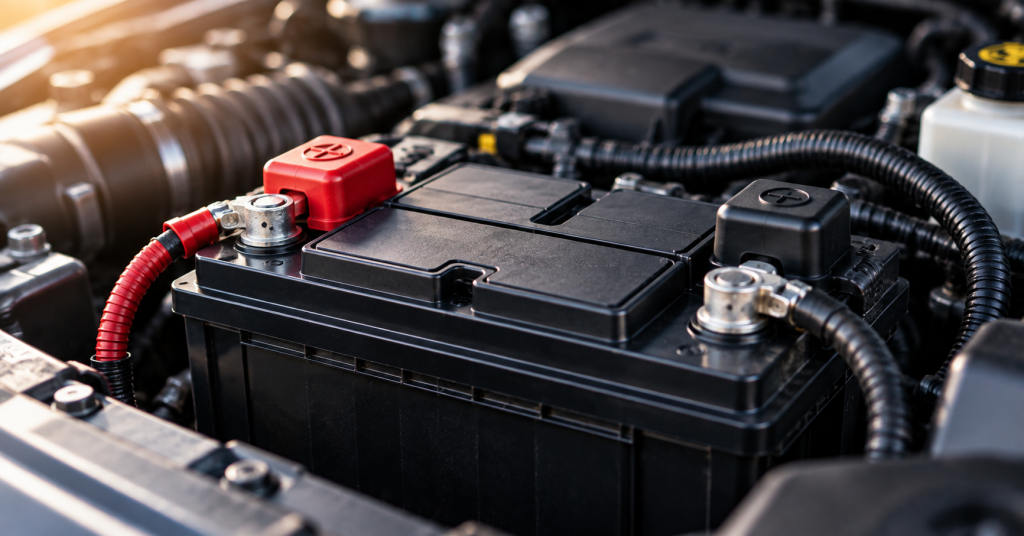
Car battery drain happens when something keeps drawing current after you switch the car off. A normal parked car draws 20 to 50 milliamps to keep memory and security systems alive. Anything consistently above 50 to 85 milliamps is a parasitic drain, and the usual causes are badly wired accessories, a control module that never goes to sleep, a stuck relay, or a boot or glovebox light that stays on.
At Dubai Auto Repair, the classic version of this call is a car that starts perfectly all week and is dead on Saturday morning. Nothing is wrong with the battery. Something has been quietly emptying it for four days.
This guide covers what normal draw looks like in numbers, how long each level takes to flatten a battery, the eight causes we find most, and how heat makes the problem worse here even when nothing is faulty.
Key takeaways
- A parked car normally draws 20 to 50 milliamps, so a small draw is not a fault
- Above 200mA, a typical battery will not start the car after less than a week of standing
- Modules can take up to an hour to fully sleep, and testing too early gives a false reading
- Self-discharge roughly doubles with every 10°C, so a Dubai summer flattens a parked car with no fault at all
- Badly installed dashcams, alarms and trackers are the most common cause we find
Your car draws current even when parked
This surprises people. A modern car switched off, locked and sitting still is never fully off.
The engine management module holds its learned settings. The body control module listens for the key fob. The alarm stays armed. The clock runs. The infotainment keeps its presets.
All of that needs a small, continuous supply, and it is designed in.
| Draw reading | What it means |
|---|---|
| 20 to 50 mA | Normal for most modern cars once modules have slept |
| 50 to 85 mA | Upper end of normal on newer, electronics-heavy vehicles |
| 85 to 200 mA | Worth investigating |
| 200 to 500 mA | A definite fault, will strand you within days |
| Above 1 A | Severe, will flatten a healthy battery overnight |
Older and simpler cars sit at the lower end, typically under 25mA, because they have fewer modules to keep awake.
How long each drain takes to flatten a battery
Numbers make this concrete. The table below assumes a 60Ah battery starting fully charged, and that it stops being able to crank the engine once roughly half its capacity is gone, which is a reasonable working figure for a healthy battery in a hot climate.
| Drain | Roughly how long until it will not start |
|---|---|
| 50 mA (normal) | About 25 days |
| 100 mA | About 12 days |
| 200 mA | About 6 days |
| 500 mA | Under 3 days |
| 1 A | Just over a day |
| 2 A | Overnight |
These are approximations, not a specification. A larger battery lasts longer, an older one considerably less, and heat shortens every row.
But the shape of it explains the pattern most people describe. A drain of a few hundred milliamps is invisible on a car driven daily, because each journey puts back what the previous night took out. The same drain strands you after a long weekend or a business trip.
The eight causes we find most often
Badly installed accessories. The most common by a distance in Dubai. Dashcams, alarms, trackers, parking sensors and upgraded audio all need a supply, and a hardwired dashcam with a parking mode is designed to keep drawing current. Whether that is acceptable depends entirely on how much and whether the installer used a switched feed or a permanent one.
A module that will not sleep. Infotainment units, body control modules and telematics units sometimes fail to enter sleep mode after a software glitch or a fault. The car sits there wide awake all night.
A stuck relay. Relay contacts wear and occasionally weld closed, leaving a circuit energised permanently. Heat accelerates this, which is why it is more common here.
Interior and compartment lights. Boot, glovebox and vanity mirror lights with failed switches. Easy to miss because you never see them on with the doors closed.
A failing diode in the alternator. Alternators contain a rectifier, and a shorted diode allows current to flow backwards through it when the engine is off. It produces a steady drain that no fuse pull will isolate, because it bypasses the fuse box entirely.
Damaged wiring. A chafed wire touching bare metal creates a path to ground that draws current continuously. Often traces back to a previous accessory installation.
A faulty door or bonnet switch. The car thinks a door is open, so it keeps interior systems awake.
Aftermarket immobilisers and GPS trackers. Common in Dubai for insurance and fleet reasons, and they draw current by design. A well-chosen unit draws very little. A cheap one can draw enough to matter.
The Dubai factor: heat empties a battery on its own
This part is worth understanding before you go hunting for a fault that may not exist.
Every battery self-discharges even when perfectly healthy and disconnected from everything. A lead acid battery loses roughly 5 percent of its charge per month at normal temperature.
Temperature changes that dramatically. Battery University notes that self-discharge increases with temperature and the rate typically doubles with every 10°C. Work that forward from 25°C to a Dubai summer and the monthly loss climbs several times over.
So a car left standing for a month in August can lose a significant share of its charge with no parasitic drain whatsoever. Add a normal 50mA draw on top and a healthy battery can genuinely be flat after a few weeks away, with nothing wrong with the car.
There is a second consequence. A battery sitting at low charge sulfates, which permanently reduces capacity. That is why a car left at the airport for a month over summer often needs a new battery rather than just a jump start, and it is part of why batteries last only two to three years in Dubai heat.
If you travel for long periods, a smart trickle charger or a battery disconnect switch is cheaper than a battery.
How to test for a drain yourself
You need a multimeter that can measure DC current on a 10 amp range.
- Park the car, switch everything off, close all doors and lock it if the alarm allows testing.
- Open the bonnet first, and prop it so the under-bonnet light does not stay on. Disable the bonnet switch if there is one.
- Wait. This is the step everyone gets wrong, and it is covered below.
- Disconnect the negative battery cable and connect the multimeter in series between the cable and the terminal, so all current flows through the meter.
- Start on the 10 amp range, not milliamps, or a high draw will blow the meter’s fuse.
- Read the settled figure. Once you are confident it is below an amp, switch to the milliamp range for precision.
- If the reading is high, pull fuses one at a time and watch for the reading to drop. The fuse that changes it identifies the circuit.
Two safety notes. Never start the engine or switch on headlights with the meter connected, because starting current will destroy it. And on cars with security systems, disconnecting the battery can trigger a radio code request or an alarm sequence, so check before you begin.
The mistake that ruins the test
Almost every failed home attempt at this comes down to one thing: testing too early.
When you switch a modern car off, the modules do not shut down immediately. They stay awake, finish their housekeeping, and enter sleep mode in stages. That process typically takes 15 to 30 minutes, and on some vehicles deep sleep takes up to an hour.
Test at five minutes and you will see several hundred milliamps and conclude you have found a serious fault. Wait properly and the same car settles to 35mA.
It gets worse. Opening a door, unlocking the car, or even connecting the meter can wake the modules back up and restart the whole timer. Pulling and reinserting fuses does the same thing on some vehicles, which is why fuses should be pulled one at a time with a pause between each.
If you take one thing from this guide: wait thirty minutes minimum before you trust the number.
How the fault gets found properly
The fuse-pull method works but it is slow and it disturbs the very modules you are trying to keep asleep.
The faster approach measures voltage drop across each fuse without removing it. A fuse carrying current develops a tiny voltage across its terminals, measurable in millivolts at the exposed test points on top. Because nothing gets disconnected, the car stays asleep throughout and the readings stay valid.
Once the circuit is identified, the wiring diagram narrows it to a component, and disconnecting that component confirms it.
The other technique is time. Some drains are intermittent, appearing only after the car has sat for hours or only when the temperature drops. A meter left connected and logging overnight catches those, and that is far easier to do where the car normally parks than in a workshop bay with a queue behind it.
When it is not a drain at all
Three things produce the same symptom and get misdiagnosed regularly.
The battery is simply worn out. After two or three Dubai summers, capacity has dropped enough that normal draw plus normal self-discharge is sufficient to flatten it. There is no fault to find.
The alternator is not charging properly. The car never starts each day fully charged, so it arrives at the weekend with far less reserve than it should have.
Short trips. Starting an engine costs a meaningful amount of charge, and a ten-minute drive may not put it back. Over weeks the battery drifts downward regardless of drain.
All three are ruled out with a load test and a charging voltage reading before anyone starts pulling fuses. Doing it the other way round wastes hours.
What it costs in Dubai
| Work | Typical Dubai range |
|---|---|
| Battery and charging system test | AED 0 to 150 |
| Parasitic drain diagnosis | 1 to 2 hours of labour |
| Labour rate | AED 100 to 200 per hour |
| Rewiring a badly installed accessory | AED 150 to 500 |
| Relay or switch replacement | AED 150 to 300 |
| Wiring fault repair | AED 500 to 2,000 |
The repair is usually cheap. The diagnosis is where the time goes, which is the pattern across most electrical work. Our guide to car service costs across Dubai covers how labour rates vary between workshop tiers.
Our auto electrical repair service covers battery and charging system testing, parasitic drain tracing and accessory rewiring wherever your car is parked, which suits this job particularly well because the car can stay where it normally sleeps.
Frequently asked questions
What is a normal parasitic draw on a car?
Between 20 and 50 milliamps for most modern cars once the modules have entered sleep mode, and up to 85mA on newer electronics-heavy vehicles. Older cars typically sit under 25mA.
Why does my car battery drain overnight?
A draw of around 1 amp or more will flatten a healthy battery overnight. Common causes are a module that will not sleep, a stuck relay, a compartment light staying on, or a badly wired accessory.
Can a dashcam drain my car battery?
Yes, particularly one hardwired with parking mode enabled, which keeps recording after you switch off. A properly installed unit uses a low-voltage cutoff so it stops before the battery is compromised.
How long does a parasitic drain test take?
Around an hour for a straightforward one, including the waiting time for modules to sleep. An intermittent drain takes longer, because the meter has to stay connected until the fault appears.
Why does my car battery go flat when I leave it parked for weeks?
Self-discharge plus normal draw. Self-discharge roughly doubles with every 10°C rise, so a car left standing in a Dubai summer loses charge far faster than the same car would in a mild climate, even with nothing faulty.
Will disconnecting the battery fix a drain?
It prevents the battery going flat while parked, which helps if you travel often. It does not fix the underlying fault, and on many cars it means losing radio codes and stored settings each time.
Before you replace the battery again
If this is your second battery in two years, the battery is probably not the problem.
Get the charging voltage read, then get the current draw measured after the car has properly gone to sleep. Two readings, about an hour, and they tell you whether you are looking at a component, an accessory, or simply a battery that has served its time in this climate.
Get in touch and we will come to you.

