
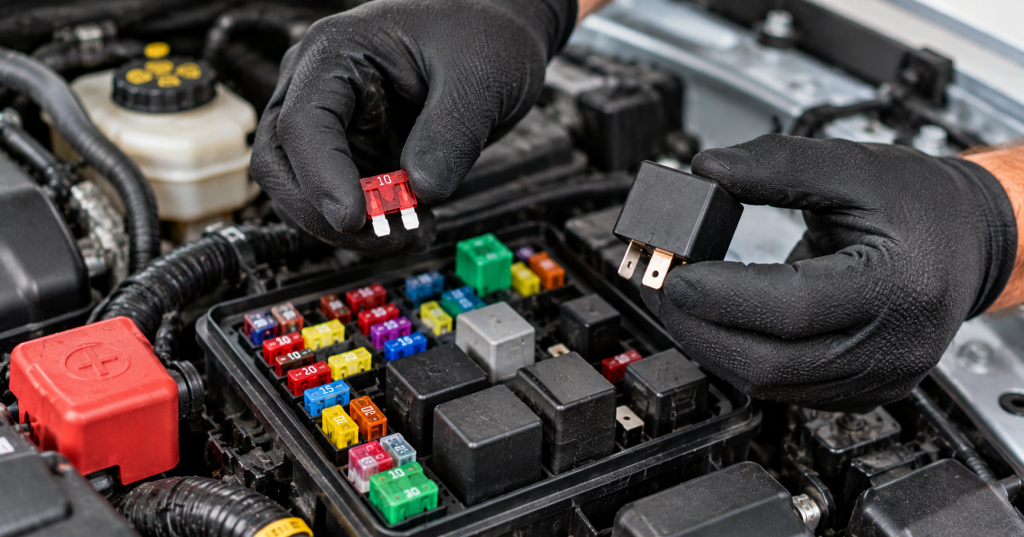
A car fuse relay problem can cause headlights, cooling fans, horns, fuel pumps, power windows, AC components, or other electrical systems to stop working or operate intermittently. A blown fuse usually interrupts a circuit, while a faulty relay may fail to switch power correctly. Proper electrical testing can identify the actual fault.
Fuses and relays are small components, but they control and protect important electrical circuits throughout a vehicle. When one fails, the symptoms can make a relatively small electrical problem appear much more serious.
At Dubai Auto Repair, electrical faults should be diagnosed before parts are replaced. This guide explains seven common fuse and relay problem signs, how to tell them apart, why fuses keep blowing, how technicians test the circuit, and when professional diagnosis is necessary.
Key Takeaways
- A fuse protects an electrical circuit from excessive current.
- A relay acts as an electrically controlled switch.
- A blown fuse can cause a circuit to stop working completely.
- A faulty relay may cause intermittent or complete electrical failure.
- A clicking relay can still have faulty internal contacts.
- Repeated fuse failure usually indicates another circuit problem.
- Never install a higher-amperage fuse to stop repeated failure.
- Wiring and connector faults can imitate fuse or relay problems.
What Do Fuses and Relays Do?
A car fuse protects wiring and electrical components by opening the circuit when current becomes excessive. A relay uses a control signal to switch another electrical circuit, allowing vehicle systems to operate higher-current components safely.
A fuse contains a metal element designed to open when current exceeds its intended limit. Once the element breaks, electricity can no longer pass through that fuse.
Relays commonly control systems such as cooling fans, horns, fuel pumps, starter circuits, lighting, and some AC components.
Modern vehicles can also use electronic modules or solid-state switching instead of traditional removable relays. Vehicle-specific wiring information therefore matters during diagnosis.
7 Signs of a Car Fuse Relay Problem
Common signs of a car fuse relay problem include a dead electrical circuit, intermittent operation, repeated fuse failure, relay clicking without component operation, devices staying powered, fuse-box overheating, and several related electrical faults appearing together.
These symptoms help narrow the search, but testing should confirm the cause.
1. One Electrical System Stops Working
A suddenly dead horn, light, accessory socket, fan, or another electrical component can indicate a blown fuse.
However, the problem could also involve a relay, switch, broken wire, poor ground, failed load, or control module.
Our guide to car electrical repair in Dubai covers other electrical faults that can cause vehicle systems to stop working.
Check the circuit rather than assuming the fuse caused the problem.
2. The Component Works Intermittently
An electrical component that works sometimes and fails at other times may have a relay or connection problem.
Worn relay contacts can behave inconsistently. Heat, vibration, loose terminals, and damaged wiring can produce similar symptoms.
If the fault appears only when the vehicle is hot or after driving, tell the technician. Reproducing those conditions can make intermittent faults easier to diagnose.
3. The Fuse Keeps Blowing
A fuse that repeatedly blows usually indicates an underlying electrical problem.
Possible causes include:
- Short circuits
- Damaged wire insulation
- Excessive current draw
- Failing electrical motors
- Damaged connectors
- Incorrect accessory installation
- Wrong fuse rating
- Internal component faults
Replacing the fuse repeatedly does not repair the cause. Never install a higher-amperage fuse because the correct one keeps blowing. The specified fuse protects wiring and components from excessive current.
4. Relay Clicks but Nothing Works
Hearing a relay click does not prove the relay is healthy. The click may show that the relay coil is energised, but damaged internal contacts may still prevent current from reaching the electrical load.
The problem can also exist elsewhere in the circuit, including damaged wiring, poor grounds, missing power feeds, or a failed component.
Treat the click as a diagnostic clue rather than proof that the relay works.
5. Electrical Device Stays On
A relay that does not switch off correctly may leave an electrical device powered.
For example, a fan, pump, or light may continue operating unexpectedly. This can also contribute to battery discharge after parking.
However, stuck relay contacts are only one possibility. Wiring shorts, module commands, and control-circuit faults can produce similar behaviour.
If your battery repeatedly becomes flat after parking, read our guide to car battery drain causes.
6. Fuse Box Gets Hot
Heat, melted plastic, discoloration, or a burning smell around the fuse or relay box requires attention.
Possible causes include excessive current, loose terminals, corrosion, high resistance, overheated relay contacts, or damaged sockets. Replacing only the fuse or relay may not solve heat damage inside the connector.
If you notice melting or a strong burning smell, stop using the affected electrical system and arrange an inspection.
7. Several Electrical Problems Appear Together
Multiple electrical faults can sometimes share one power supply, ground, fuse, relay, or distribution point.
However, modern vehicles have complex electrical networks. Several warning lights do not automatically mean that one fuse has failed.
Proper electrical system diagnostics can trace the shared circuit before unrelated components are replaced.
Blown Fuse vs Faulty Relay
A blown fuse usually opens a circuit and causes consistent loss of power, while a faulty relay can cause complete failure, intermittent operation, or incorrect switching. Wiring and electrical-load faults can produce similar symptoms, so testing provides the final answer.
| Symptom | Fuse More Likely | Relay More Likely |
|---|---|---|
| Circuit completely dead | ✓ | Possible |
| Fuse tests open | ✓ | — |
| Fuse repeatedly blows | ✓ / circuit fault | Less likely |
| Intermittent operation | Possible | ✓ |
| Relay clicks but device stays off | Less likely | ✓ / downstream fault |
| Device stays powered | — | Possible |
| Works after correct relay substitution | — | ✓ |
| Melted socket | Possible | Possible |
A fuse can sometimes look normal but test open. A relay can click while failing to pass current through its load contacts.
Appearance and sound alone are therefore insufficient.
Why Does a Fuse Keep Blowing?
A car fuse usually keeps blowing because current in the protected circuit exceeds its designed limit. A short circuit, damaged wiring, failing electrical load, connector problem, or incorrect modification can all cause excessive current.
One common cause is damaged wire insulation. A powered wire can contact ground and create a short circuit.
Wiring damage may be hidden inside a harness, behind trim, or within the engine bay. Our car wiring repair guide explains why these faults require proper tracing.
Electrical motors can also cause fuse failure. A restricted or internally damaged fan, blower, or pump may draw excessive current.
If fuse problems began after electrical modifications, that information can help identify the cause.
How Are Fuse and Relay Problems Tested?
Fuse and relay diagnosis checks the protected circuit rather than simply replacing components. A technician may inspect the fuse box, test power and ground, check continuity where appropriate, verify relay commands, and trace voltage through the circuit.
A typical process includes:
- Identify the correct fuse and relay.
- Confirm the specified fuse rating.
- Inspect the fuse, relay, socket, and wiring.
- Test the fuse electrically.
- Verify circuit power and ground.
- Check the relay control signal.
- Check switched relay output.
- Inspect the electrical load and wiring if the fault remains.
Fluke’s automotive continuity-testing guidance explains that continuity testing can help identify open circuits in fuses, wires, switches, and relays.
Continuity or resistance testing should not be performed on a powered circuit.
A technician may sometimes compare a suspected removable relay with an identical compatible relay when the vehicle’s design allows it. Random relay swapping is not recommended because similar-looking relays can have different specifications or terminal arrangements.
Fuse vs Relay vs Wiring Problem
Fuse, relay, and wiring faults often create overlapping symptoms. Diagnosis should identify where power or ground disappears and whether the relay receives and passes the correct electrical signal.
| Fault | Typical Pattern | Diagnostic Focus |
|---|---|---|
| Blown fuse | Circuit loses power | Fuse and protected circuit |
| Faulty relay | No/intermittent switching | Control and load sides |
| Open wire | Power stops in circuit | Wiring continuity |
| Short to ground | Fuse may repeatedly blow | Wiring/current draw |
| Poor ground | Weak or erratic operation | Ground/voltage drop |
| Bad connector | Intermittent/high resistance | Connector and terminals |
| Failed load | Component stays inactive | Electrical load |
Following the circuit usually produces a more reliable diagnosis than replacing the most obvious component.
Can a Fuse Look Good but Be Bad?
Yes. A fuse can appear normal while having a break that is difficult to see. Poor contact, corrosion, or heat damage at the fuse terminals can also prevent the circuit from working correctly.
Electrical testing provides stronger evidence than visual inspection alone.
The fuse socket should also be checked. If the fuse tests correctly but the circuit still lacks power, the fault may be elsewhere in the circuit.
Can You Replace a Car Fuse Yourself?
An accessible car fuse can usually be replaced when you correctly identify the circuit and use exactly the specified fuse type and amperage. Repeated fuse failure, melting, burning smells, or uncertainty about the circuit requires diagnosis instead of continued replacement.
Check the owner’s manual or vehicle-specific fuse information first.
Never install a higher-rated fuse to prevent repeated blowing. Doing so can allow more current through wiring than the circuit was designed to carry.
If the correct replacement fuse immediately fails again, stop replacing fuses and diagnose the underlying problem.
When to Book Fuse and Relay Diagnosis
Book electrical diagnosis when a fuse repeatedly blows, a relay-controlled component operates intermittently, the circuit stays dead after correct fuse replacement, or you find heat damage around the fuse box. These symptoms may indicate wiring, connector, load, or control-system faults.
At Dubai Auto Repair, diagnosis can trace the circuit before unnecessary components are replaced.
If the problem prevents the engine from cranking, our starter motor repair Dubai guide explains how batteries, starter circuits, relays, and wiring can produce similar no-crank symptoms.
If the vehicle becomes unusable, our mobile mechanic vs garage in Dubai comparison explains when on-site diagnosis may make sense.
Frequently Asked Questions
Q1: How do I know if a fuse or relay is bad?
A blown fuse often causes a circuit to stop working completely, while a faulty relay can cause complete or intermittent failure. Electrical testing of the fuse, relay circuit, wiring, and load provides a more reliable diagnosis than symptoms alone.
Q2: What happens when a car relay goes bad?
A faulty relay may stop an electrical component from receiving power, work intermittently, fail under certain conditions, or sometimes leave a device switched on. The exact symptoms depend on the circuit it controls.
Q3: Why does the same fuse keep blowing?
A repeatedly blown fuse usually means excessive current is flowing in the circuit. Common causes include a short circuit, damaged wiring, a failing electrical load, connector damage, or incorrectly installed accessories.
Q4: Does a clicking relay mean it is good?
No. A click can indicate that the relay coil is responding, but the internal contacts may still fail to carry current. The relay’s switched output and the rest of the circuit should be tested.
Q5: Can I use a higher-amp fuse?
No. Always use the fuse type and amperage specified for that circuit. A higher-rated fuse can allow excessive current through wiring and increase the risk of electrical damage or overheating.
Q6: Can a bad relay drain the battery?
Yes. Certain relay or control faults can leave an electrical load powered after the vehicle is switched off. However, many other electrical problems can also cause battery drain, so diagnosis is necessary.
Q7: Can a fuse be bad even if it looks fine?
Yes. A visual inspection can miss a small break or connection problem. Electrical testing can confirm whether the fuse has a continuous electrical path.
Q8: How much does fuse or relay repair cost in Dubai?
Fuse and relay repair cost in Dubai depends on the actual fault. Replacing a simple component differs significantly from tracing damaged wiring, repairing an overheated socket, or diagnosing a complex control-system problem.
Final Thoughts
A car fuse relay problem should be diagnosed by finding where electrical power or control is being lost. Blown fuses, faulty relays, damaged wiring, poor connections, and failed electrical loads can produce similar symptoms.
Pay particular attention to a fuse that repeatedly blows. The fuse is protecting the circuit, so fitting a higher-rated fuse is not a repair.
Testing the circuit first can identify the actual fault and prevent unnecessary parts replacement.
If your vehicle has repeated fuse failures, intermittent electrical systems, or a dead relay-controlled circuit, contact Dubai Auto Repair for electrical fault diagnosis and repair.

