
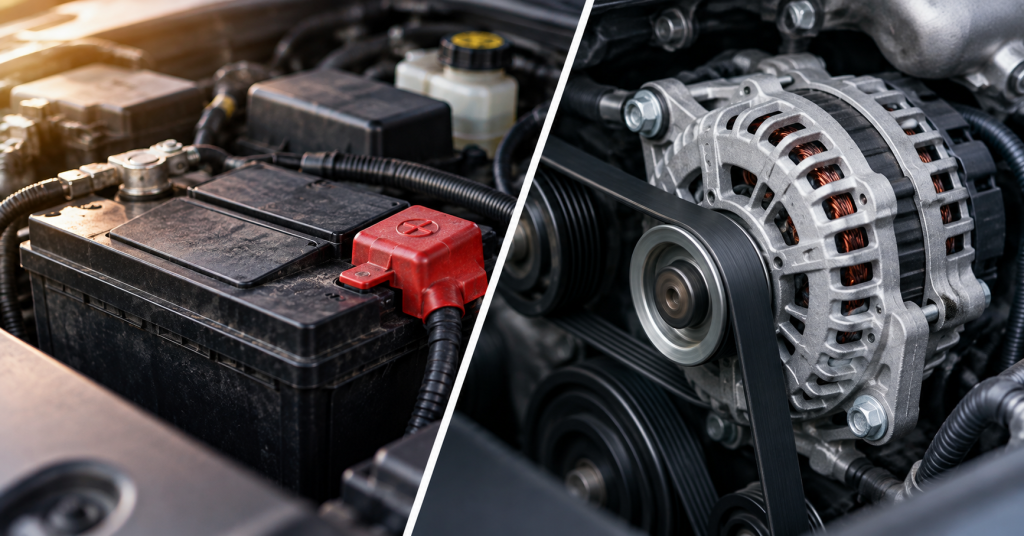
The quickest way to tell a battery problem from an alternator problem is the jump start test. If the car starts on jump leads and keeps running after you disconnect them, the battery is the fault. If it starts and dies within a minute or two of removing the leads, the alternator is not charging. A resting battery should read around 12.6 volts, and a healthy charging system should read 13.5 to 14.7 volts with the engine running.
At Dubai Auto Repair, this is the question behind a large share of our electrical callouts, and getting it wrong is expensive in a specific way. A new battery fitted to a car with a failing alternator will be flat again within weeks, and you will have paid for a battery that was never the problem.
This guide gives you three tests you can do yourself, what each voltage reading means, the symptoms that separate battery from alternator from starter, and the situations where the answer is neither.
Key takeaways
- The jump start test separates the two in under two minutes
- Dim lights that brighten when you rev point at the alternator, not the battery
- The battery warning light usually indicates a charging system fault, not a dead battery
- A corroded terminal produces exactly the same symptom as a flat battery
- A failing alternator ruins batteries, so replacing one without checking the other repeats the problem
Test one: the jump start test
This is the most decisive test available without equipment.
Jump start the car following the correct procedure and lead order. Once it is running, leave it idling for a minute, then disconnect the leads.
The car keeps running. The alternator is producing charge and the battery could not hold enough to start the engine. Battery problem.
The car dies within a minute or two. The engine was running on whatever the jump pack supplied, and the alternator is not replacing it. Alternator or charging system problem.
The car will not start at all on jump leads. Neither, most likely. Look at the starter motor, the connections, or something mechanical.
One caution. Do not do this repeatedly on a car that keeps dying, because running an engine on a badly undercharged system is hard on the electronics. One test tells you what you need.
Test two: the headlight test
No tools at all, and it takes thirty seconds.
Start the engine, let it idle, and look at the headlights against a wall. Then rev gently to around 2,000 rpm.
Lights dim at idle and brighten noticeably when you rev. Alternator. Its output rises with engine speed, and a weak one only produces enough at higher revs.
Lights are dim and stay dim regardless. Battery, or a supply and connection problem.
Lights are bright but the engine cranks slowly. This combination is the useful one. A flat battery dims the lights while cranking. Bright lights with a slow, laboured crank points at the starter motor instead.
Lights flicker or pulse at steady revs. Usually a failing voltage regulator inside the alternator, or a loose drive belt.
Test three: the voltage test
This one needs a basic multimeter, which costs very little and is worth owning.
Take two readings. First with the engine off and the car having sat for a few hours. Then with the engine running at idle.
| Reading | Condition | What it means |
|---|---|---|
| 12.6V or above | Engine off, rested | Battery fully charged |
| 12.4V | Engine off, rested | Around 70 to 75 percent charged |
| 12.2V | Engine off, rested | Around half charged, needs investigating |
| Below 12.0V | Engine off, rested | Deeply discharged, and repeated discharge damages the battery |
| 13.5V to 14.7V | Engine running | Charging system working normally |
| Below 13.5V | Engine running | Alternator not keeping up, or a belt or connection problem |
| Above 15V | Engine running | Overcharging, usually a failed voltage regulator, which cooks batteries |
The combination is what tells the story. Low resting voltage with normal charging voltage means a tired battery. Normal resting voltage with low charging voltage means an alternator that is not doing its job. Both low usually means an alternator that has already ruined the battery.
Why the voltmeter is not the final word
Worth being honest about a limitation almost no guide mentions.
Voltage-based state of charge is an approximation, and on a modern car it is a rough one. Battery University notes that an accurate open circuit reading requires the battery to rest with no load attached, and that modern vehicles never fully achieve this because housekeeping electronics keep drawing small amounts of current. They also note that a battery needs to rest for at least four hours, and that manufacturers prefer 24, before the voltage represents the true state of charge.
So a voltmeter tells you the direction. It does not tell you capacity.
A battery can read a healthy 12.6 volts and still fail under the load of starting, because voltage measures pressure while starting demands current. That is what a proper load test measures, and it is the test that gives a definitive answer on whether a battery is finished.
Symptoms side by side
| Symptom | Battery | Alternator | Starter |
|---|---|---|---|
| Rapid clicking, no crank | Likely | Possible | Possible |
| Single loud click, no crank | Unlikely | Unlikely | Likely |
| Slow crank with dim lights | Likely | Possible | Unlikely |
| Slow crank with bright lights | Unlikely | Unlikely | Likely |
| Dies while driving | Unlikely | Likely | No |
| Battery warning light on | Unlikely | Likely | No |
| Whining or grinding noise | No | Likely | Possible |
| Fine after a jump, dies later | Likely | Likely | No |
| Burning rubber smell | No | Likely, slipping belt | No |
The two rows worth memorising are the crank-with-bright-lights one and the dies-while-driving one. A car that cuts out while you are moving is almost never the battery, because the alternator should be running everything at that point.
The battery warning light does not mean the battery
This causes more confusion than any other dashboard symbol.
The light shaped like a battery monitors system voltage, not battery health. It comes on when the charging system stops delivering the voltage it should, which normally means the alternator, the drive belt, or the wiring between them.
If it comes on while you are driving, you are running on battery reserve alone. You typically have somewhere between twenty and sixty minutes before the car stops, less with headlights and air conditioning running, which in Dubai is always.
Head somewhere you can stop safely rather than continuing your journey, and switch off anything you do not need. Our guide to what to do if your car breaks down in Dubai covers getting off the carriageway safely if it does stop.
When it is neither
Three situations produce identical symptoms and get misdiagnosed regularly.
A corroded or loose battery terminal. White or blue crust on the posts, or a clamp you can rotate by hand, restricts current flow and behaves exactly like a flat battery. It is the cheapest fix on this page and worth checking before anything else.
A parasitic drain. Something continues drawing current after you switch off. The car starts fine daily and is dead after a long weekend. Dashcams, alarms and trackers wired to a permanent live are the usual causes here.
A slipping or worn drive belt. The alternator can be perfect while the belt turning it slips. You get low charging voltage, and often a squeal on startup or a burning rubber smell.
None of the three is fixed by a new battery, and all three are cheaper than an alternator.
How one kills the other, and why Dubai speeds it up
These two components are linked, which is why diagnosing only one is a mistake.
A failing alternator undercharges the battery. A chronically undercharged lead acid battery sulfates, losing capacity permanently. So an alternator fault quietly destroys a healthy battery over a few weeks.
It works the other way too. A degraded battery makes the alternator work harder and run hotter trying to charge something that will not hold charge, which shortens the alternator’s life.
Heat accelerates both. Batteries here last two to three years rather than four to five, for reasons we set out in our guide to car battery life in Dubai heat. Alternators sit in the same hot engine bay and run harder because the air conditioning is on for most of the year.
The practical conclusion: whichever one you replace, have the other tested at the same time. It takes minutes and it stops you doing the job twice.
What each repair costs in Dubai
| Work | Typical Dubai range |
|---|---|
| Battery and charging system test | AED 0 to 150 |
| Battery terminal cleaning | AED 50 to 150 |
| Battery replacement, fitted | AED 200 to 1,500 |
| Drive belt replacement | AED 150 to 600 |
| Alternator repair | from AED 250 |
| Alternator replacement | AED 500 to 1,500 |
| Parasitic drain diagnosis | 1 to 2 hours of labour |
Look at the top of that table. A test that costs nothing or very little tells you which of the rows below you actually need. Our breakdown of car service costs across Dubai covers how labour rates differ between workshop tiers, which is what moves these figures most.
A battery fitted on a guess, on a car whose alternator was the real fault, is the full battery price plus the same problem in three weeks. That is the arithmetic worth remembering.
Getting it tested properly
A full test takes about fifteen minutes and covers four things: battery state of charge, battery capacity under load, charging voltage at idle and at raised revs, and current draw with everything switched off.
Those four separate every scenario on this page. Anyone selling you a battery without doing at least the first three is guessing.
All of it happens wherever your car is parked. Our auto electrical repair service covers battery and charging system testing, alternator and starter work, terminal and connection repairs and parasitic drain tracing, and if the battery does turn out to be the answer, we fit it there.
Frequently asked questions
How do I know if it is my battery or alternator?
Jump start the car and disconnect the leads. If it keeps running, the battery is at fault. If it dies within a minute or two, the alternator is not charging. Dim lights that brighten when you rev also point at the alternator.
Can a bad alternator ruin a new battery?
Yes. An alternator that undercharges leaves the battery in a permanent state of partial discharge, which causes sulfation and permanent capacity loss. This is why a new battery goes flat again within weeks on a car with a charging fault.
What voltage should my car battery be?
Around 12.6 volts or above with the engine off after resting. With the engine running, 13.5 to 14.7 volts indicates the charging system is working. Below 13.5 running suggests the alternator is not keeping up.
Does the battery warning light mean I need a new battery?
Usually not. That light monitors charging system voltage, so it more often indicates an alternator, drive belt or wiring fault. Driving with it lit will flatten a healthy battery.
How long can I drive with the battery light on?
Roughly twenty to sixty minutes on battery reserve alone, and less with headlights and air conditioning running. Head somewhere you can stop safely rather than continuing your journey.
Why does my new battery keep dying?
Either the alternator is not charging it, something is drawing current after you switch off, or a terminal connection is poor. All three produce the same symptom as a dead battery and none is fixed by another battery.
Before you buy a battery
Ask for the charging voltage reading. One number, fifteen seconds, and it decides whether the battery in front of you is the answer or the next casualty.
Most of the time the battery genuinely is the problem, because in this climate they wear out fast. But the cases where it is not are the ones that cost people twice, and separating them takes almost no effort.
Get in touch and we will come to you.

