
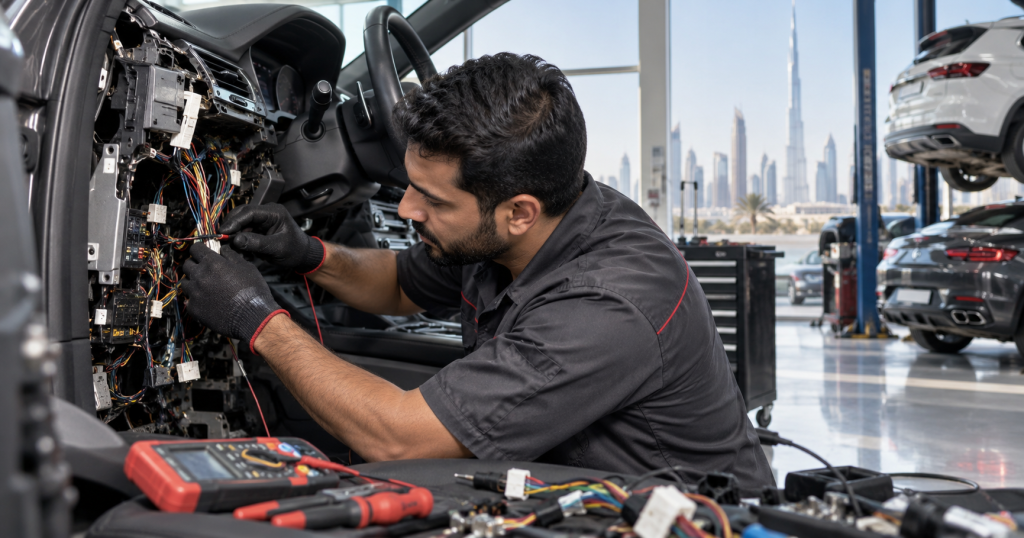
Car wiring repair means locating the damaged section of a loom and repairing or replacing that section, rather than replacing the whole harness. Wiring fails in predictable places: where a loom flexes, where it passes over an edge, and where heat or moisture reaches it. In Dubai, heat is the main cause, because it turns flexible insulation brittle over a few summers.
At Dubai Auto Repair, wiring faults are the ones drivers describe as “the car is possessed”. Something works, then stops, then works again, and nothing about it makes sense. It usually makes perfect sense once you find the wire.
This guide covers where looms actually fail, the five causes we see here, how a proper repair differs from a bad one, and what wiring work costs across Dubai.
Key takeaways
- Wiring almost always fails at flex points, edges and heat sources, not in the middle of a straight run
- Aftermarket dashcams, alarms and sound systems cause more wiring damage here than anything else
- A taped splice fails in Dubai heat, because tape adhesive degrades and unwinds
- A proper repair is soldered or crimped and sealed inside adhesive-lined heat shrink
- Most looms can be repaired in sections, so full harness replacement is rarely necessary
Where car wiring actually fails
Knowing the six usual locations narrows the search enormously, because a wire almost never fails in the middle of a protected straight run.
Door harnesses. The loom running through the rubber boot between door and body flexes every single time the door opens. Symptoms are windows, mirrors, speakers or central locking on one door acting up.
Tailgate and boot harnesses. Same problem, and the number plate lights, reversing camera and boot release are the usual casualties.
Bulkhead grommets. Where the loom passes from engine bay to cabin. If the grommet perishes or was disturbed during a previous repair, the wires chafe against a metal edge.
Near heat sources. Looms routed close to the exhaust manifold, turbocharger or engine block. Insulation there ages fastest, and in Dubai it ages faster still.
Under seats and carpets. Seat motors, airbag sensors and seatbelt pretensioners all have wiring that gets crushed by seat rails or damaged during interior work.
Anywhere somebody has been before. Previous repairs, alarm installations and audio fitting account for a large share of what we find.
The five causes of wiring damage in Dubai
Heat and brittle insulation
Wire insulation is a polymer with a service temperature range. Sustained heat above that range makes it harden, lose flexibility and eventually crack.
Under-bonnet temperatures here run far above the ambient figure on your weather app, for eight or nine months a year. A loom that would stay supple for fifteen years in Europe can go brittle in six or seven.
Brittle insulation cracks wherever the loom moves, which brings you back to the flex points above.
Chafing and vibration
A loom that rests against a bracket or passes over a panel edge slowly wears through. Every bump contributes.
The symptom is a fault that appears on rough roads or over speed bumps and clears on smooth tarmac. That pattern is close to diagnostic on its own.
Rodent damage
Real, and more common in cars that sit outside or in older buildings with open parking.
You may have read that modern soy-based wire insulation attracts rodents. Worth being accurate about this: class action lawsuits were filed against several manufacturers on that basis, and courts dismissed them for insufficient evidence, while the manufacturers denied the claim. The consensus is simply that rodents gnaw because they need to gnaw, on any insulation, of any material.
So the defence is not about what your wires are made of. It is about not giving rodents a reason to nest under your bonnet: no food waste nearby, and check occasionally if the car sits for long periods.
Aftermarket installations
This is the biggest single cause we encounter in Dubai, and it is entirely avoidable.
Dashcams, alarms, trackers, parking sensors, upgraded audio and lighting all need a power source. A proper installation takes a fused feed from the correct circuit. A bad one taps into whatever wire was nearest, often by stripping insulation mid-run and twisting a joint.
That joint becomes a fault a year later. Worse, a poorly chosen feed creates a parasitic drain, which is one reason a car with a healthy battery keeps going flat. We covered how long car batteries actually last in Dubai heat separately, and a surprising number of “bad battery” jobs turn out to be an accessory somebody wired badly.
Water and flood damage
Water in a loom does not cause an immediate fault. It causes corrosion inside the insulation, which spreads along the copper and produces failures months or years later, usually across several unrelated systems at once.
This matters most when buying a used car. The UAE prohibits the import and licensing of several categories of vehicle for exactly this reason, and the Ministry of Industry and Advanced Technology lists flooded, burnt out and scrapped vehicles among the types that cannot be imported. A car with a history of water damage will develop electrical faults, and no amount of drying prevents it.
How a wiring fault gets traced
Wiring is the hardest electrical fault to diagnose, because the damage is usually hidden inside a loom wrapped in tape and routed behind trim.
The process works backwards from the symptom. Identify which circuit is affected, get the wiring diagram, and find out what else shares that circuit’s fuse and ground. If three unrelated things fail together, the common point between them is where to look.
Then comes voltage drop testing along the run. A wire with damaged strands inside intact-looking insulation still passes a continuity test, because a few surviving strands carry enough current to satisfy a meter. Under real load it fails. Measuring voltage drop while the circuit works is what exposes it.
Wiggle testing comes last. Flexing sections of the loom while watching live data reproduces an intermittent fault and pinpoints the section. It is unglamorous and it works.
Repair the section, or replace the loom?
Almost always repair, and this is worth knowing because some workshops quote for a full harness.
A wiring loom is not a single component you swap. It is a bundle of individual wires, and a damaged section can be cut out and replaced with correctly rated wire, joined properly at each end.
Full harness replacement is genuinely necessary in a narrow set of cases: extensive fire damage, flood damage through the main loom, or damage so widespread that sectional repair would leave dozens of joints. It is expensive and labour-intensive, because it means stripping most of the interior.
If you are quoted for a complete loom on a single fault, ask why sectional repair is not possible. There is sometimes a good answer. There is often not.
Why a taped splice fails in Dubai
Here is the part that decides whether the repair holds.
The quick way to join two wires is to twist them together and wrap the joint in electrical tape. It works on the day. In this climate it does not work for long.
Electrical tape uses a pressure-sensitive adhesive with a temperature limit. Under a Dubai bonnet, that adhesive softens, the tape unwinds, and you are left with a bare twisted joint and a sticky residue on everything around it. The joint then oxidises, resistance rises, and the fault returns looking exactly like a new problem.
A repair that lasts uses a soldered or properly crimped joint sealed inside adhesive-lined heat shrink. The adhesive melts as the shrink tightens and seals the joint against moisture and dust. Wire of the correct gauge, joints staggered along the run rather than bunched at one point, and the repaired section re-secured so it cannot chafe where it did before.
One caution: some manufacturers specify crimped connections rather than solder on certain safety circuits, particularly airbag wiring, because a soldered joint is more brittle under vibration. On those circuits, follow the manufacturer’s method rather than the general rule.
The difference in cost between a good repair and a bad one is a few dirhams of consumables and twenty minutes. The difference in outcome is years.
Signs of a wiring problem
- A fault that appears on rough roads and clears on smooth ones
- Several unrelated components failing at the same time
- A fuse that blows repeatedly in the same circuit
- Flickering lights or components that work intermittently
- A burning or melting plastic smell, which needs immediate attention
- Faults that started after an accessory was fitted or bodywork was done
- Visible green or white corrosion on exposed wire
That second one is the most useful. Unrelated systems failing together points at something they share, and what they usually share is a ground point or a common section of loom.
What wiring repair costs in Dubai
Typical ranges across Dubai workshops in 2026.
| Work | Typical Dubai range |
|---|---|
| Diagnostic scan and initial testing | AED 80 to 250 |
| Tracing an intermittent wiring fault | 1 to 3 hours of labour |
| Labour rate | AED 100 to 200 per hour |
| Single wire or connector repair | AED 150 to 400 |
| Sectional loom repair | AED 500 to 2,000 |
| Door or tailgate harness repair | AED 400 to 1,200 |
| Rodent damage repair | AED 500 to 3,000 depending on extent |
Notice what drives the bill. The repair itself is usually inexpensive. The labour to find the damage is the cost, which is why a workshop that diagnoses efficiently is cheaper than one with a lower hourly rate that takes three times as long. Our guide to car service costs across Dubai covers how those rates compare across workshop tiers.
Ask for the estimate to separate diagnosis from repair. A workshop quoting a flat figure before seeing the car is guessing at both.
Can wiring repair be done at your location?
Most of it, yes. Fault tracing, connector and ground repairs, sectional loom repair, engine bay wiring, door and tailgate harness work and correcting badly installed accessories all get done where the car is parked.
There is an advantage to it beyond convenience. Intermittent wiring faults are far easier to reproduce in the conditions that cause them, at the temperature the car actually reaches, on the surface it normally sits on.
Full harness replacement needs a workshop, because it means stripping the interior over several days. So does anything requiring the dashboard to come out.
Our auto electrical repair service covers wiring inspection and fault repair along with full system diagnostics, and a good share of the calls in our guide to what to do when your car breaks down in Dubai trace back to a single damaged wire.
Frequently asked questions
How much does car wiring repair cost in Dubai?
A single wire or connector repair runs AED 150 to 400. Sectional loom repair typically costs AED 500 to 2,000. Most of that is the labour to locate the damage rather than the repair itself.
Can a damaged wiring loom be repaired, or does it need replacing?
Almost always repaired. A damaged section gets cut out and replaced with correctly rated wire, properly joined and sealed. Full harness replacement is only necessary after fire, flood or very widespread damage.
Why does my car develop electrical faults on bumpy roads?
Vibration flexes a loom with damaged insulation or a cracked wire, breaking contact momentarily. The fault clears on smooth roads because the wire makes contact again. Wiggle testing reproduces it.
Can rodents damage car wiring in Dubai?
Yes, particularly in cars parked outside or left standing for long periods. Rodents chew insulation of any material because they need to gnaw, so the defence is about not giving them a reason to nest under your bonnet.
Is a taped wire repair acceptable?
Not in this climate. Electrical tape adhesive degrades in under-bonnet heat, the tape unwinds, and the joint corrodes. A lasting repair is soldered or crimped and sealed inside adhesive-lined heat shrink.
Can bad wiring cause a car fire?
Damaged wiring is a genuine fire risk, which is why a burning smell or repeatedly blown fuses should be treated as urgent rather than left until the next service.
A note on the prices above
The figures in this guide reflect advertised ranges across Dubai workshops in 2026 and give you a sense of the market. They are not a quote. Wiring work is priced largely by the time taken to locate the fault, which cannot be known before inspection, so any workshop should confirm the figure once the damage has been found.
The repair is easy, finding it is not
Wiring faults have a reputation for being expensive, and the reputation is half earned. The wire, the heat shrink and the terminals cost almost nothing. The hour spent working out which of two hundred wires failed is the bill.
Which is why it is worth asking two questions before work starts: how will you locate it, and how will you join it. A clear answer to both usually means the fault will not return.
Get in touch and we will come to you.

