
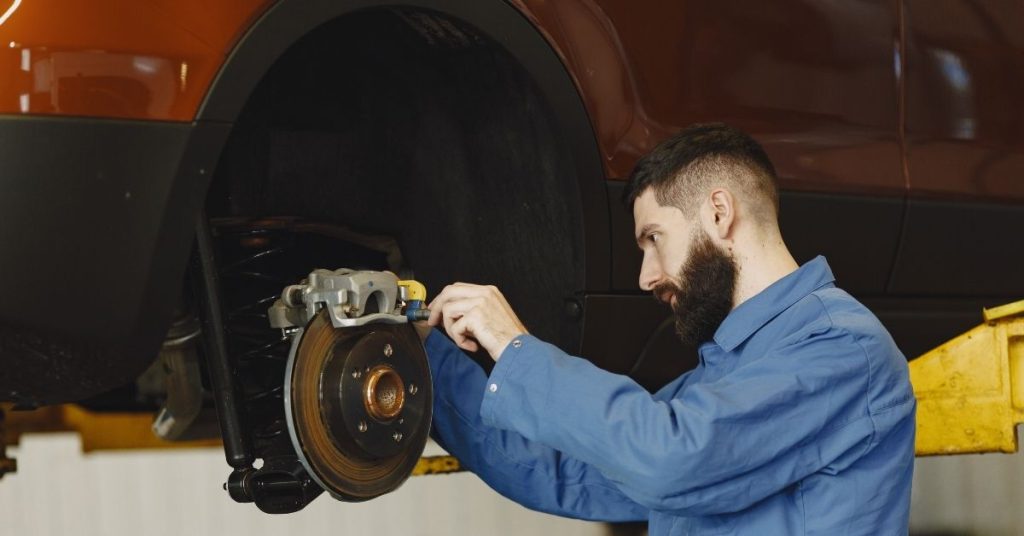
Brake pad replacement cost in Dubai runs from around AED 150 per axle on a small hatchback to AED 2,500 on a luxury European car. Most drivers pay somewhere between AED 250 and AED 800 per axle, and the number moves on three things: your vehicle’s size, the pad quality, and whether the discs need doing at the same time.
At Dubai Auto Repair, brake jobs split fairly evenly between people who booked early because they heard a squeal, and people who left it until the grinding started. The second group pays roughly three times more.
This guide covers current Dubai prices, what else lands on the bill, the warning signs in order of urgency, and the brake fluid problem that heat makes worse and almost nobody checks.
Key takeaways
- Brake pads cost AED 150 to 2,500 per axle in Dubai depending on vehicle and part quality
- Ignoring a squeal until it grinds usually adds the discs to your bill, which roughly triples it
- Brake fluid absorbs moisture over time, and heat accelerates it, so change it every two years
- Heavy SUVs in stop-start traffic warp discs here far more often than in cooler climates
- Budget pads fade faster above 40°C, which is most of the year
Brake pad replacement cost in Dubai
These are typical fitted prices per axle across Dubai workshops in 2026, including parts and labour.
| Vehicle type | Pads per axle |
|---|---|
| Small car or hatchback | AED 150 to 400 |
| Mid-size sedan | AED 250 to 800 |
| SUV or large vehicle | AED 450 to 1,000 |
| Luxury European | AED 800 to 2,500 |
| Brake discs, per axle | AED 400 to 1,200 |
| Brake wear sensors | AED 80 to 300 |
Two things explain most of that spread. Bigger, heavier vehicles need larger components, and larger components cost more. And larger wheels take longer to remove, which is labour rather than parts.
The labour rate matters as much as the parts. A workshop at AED 100 an hour and a dealership at AED 450 an hour will quote very differently for identical work, which we set out in detail in our guide to car service costs across Dubai.
What else appears on the bill
The pad price is rarely the whole quote, and knowing the other lines stops them feeling like an ambush.
Discs. If they are below minimum thickness or scored, they get replaced. A pad-only job on worn discs wears the new pads out quickly and never brakes properly.
Wear sensors. Many European cars use a sensor that triggers the dashboard warning. Once it has worn through, it needs replacing, and a car will keep showing the light without it.
Hardware kits. Anti-rattle clips, shims and retaining springs. Cheap, and reusing worn ones causes noise complaints two weeks later.
Brake fluid. Not always needed with a pad change, but frequently overdue anyway. More on this below.
Ask which of these the quote includes before you agree. A headline price that covers pads only can double once the discs go on.
Six signs your brake pads need replacing
Roughly in order of how urgently you should act.
A high-pitched squeal when braking. This is the wear indicator doing its job, a small metal tab designed to touch the disc and make noise. It is a scheduled warning, not an emergency, but it is your cheapest moment to act.
Grinding, metal on metal. The friction material has gone and the pad backing plate is cutting into the disc. Stop driving it. Every kilometre now adds disc replacement to the bill.
The brake warning light. On cars with wear sensors this is unambiguous. Book it.
Longer stopping distances or a soft pedal. A pedal that sinks further than usual points to fluid or hydraulic problems rather than pads, and that is a different and more urgent conversation.
Vibration through the pedal or steering wheel when braking. Usually warped discs. Common here, and covered below.
The car pulls to one side under braking. Uneven pad wear or a sticking caliper. Worth checking quickly because it affects control in an emergency stop.
You can also look. Through the wheel spokes you can often see the pad against the disc. Less than about 3mm of friction material means it is due.
How long brake pads last in Dubai
Pads generally last 30,000 to 70,000 km, and Dubai pushes most cars towards the lower end of that.
Three reasons. Stop-start traffic means far more brake applications per kilometre than motorway driving. Heat means the pads run hotter and wear faster. And the vehicle mix here skews heavy, with large SUVs carrying more mass into every stop.
If you drive a Land Cruiser, Patrol or similar in daily city traffic, check the pads every 20,000 km rather than waiting for a noise. If your car lives outside in direct sun, inspect more often than the manual suggests.
The seasonal maintenance calendar we put together for Dubai puts brake inspection at every service, which for most cars here means every six to nine months rather than annually.
The brake fluid problem nobody thinks about
This is the part worth reading even if your pads are fine.
Brake fluid is hygroscopic, meaning it absorbs moisture from the air over time through seals and hoses. Moisture lowers the fluid’s boiling point.
That matters because braking converts motion into heat, and that heat goes into the fluid. If the fluid boils, it forms compressible vapour in a system designed to be incompressible, and your pedal goes to the floor. That is brake fade, and it happens exactly when you need the brakes most: a long descent, heavy traffic, or repeated hard stops on a hot day.
Dubai heat accelerates the moisture absorption. So the interval that works in a temperate climate is generous here.
Brake fluid is treated as a safety-critical item in its own right. The US safety regulator maintains a dedicated standard for motor vehicle brake systems and brake fluids specifically because contaminated or improper fluid causes hydraulic brake failure, which tells you how much the fluid condition matters relative to the parts you can see.
Change it every two years or 40,000 km, whichever comes first, and lean towards the shorter side here. It is one of the cheapest items on any service bill, and it is the one most drivers have never had done.
Why Dubai warps brake discs
If your steering wheel shudders when you brake from motorway speed, this is usually why.
Repeated heavy braking generates heat in the disc. In cooler climates the disc sheds that heat between stops. In 45°C ambient with hot air moving through the wheel arch, it sheds less of it.
Add a heavy SUV and stop-start traffic, and discs run hot for long periods. Uneven cooling then leaves them with thickness variation, which you feel as vibration.
Two habits reduce it. Avoid holding the brake pedal hard at a standstill immediately after heavy braking, because that transfers pad material onto one spot on a very hot disc. And leave more following distance, which lets you brake gently over a longer distance rather than hard over a short one.
Brake dust matters too. Dubai’s dust combines with brake dust and builds up around calipers, which accelerates wear and can cause a caliper to stick. Cleaning during routine inspection deals with it.
OEM or budget pads in this climate?
Brake pads are one place where the cheapest option carries a real cost.
Friction material is formulated to work within a temperature range. Budget pads fade noticeably above around 40°C, which in Dubai means most of the year rather than an occasional bad day. Fade means longer stopping distances at exactly the wrong moment.
They also tend to wear faster, produce more dust, and are harder on discs, so the saving frequently disappears by the next replacement.
OEM or reputable OEM-equivalent pads from established manufacturers cost more upfront and hold their performance across the temperature swings. On a safety-critical component that stops two tonnes of vehicle, this is not the place to optimise for price.
Ask what brand the workshop is fitting. A vague answer is an answer.
Can brake work be done at your location?
Yes, for most of it. Pad replacement, disc replacement, caliper inspection, brake fluid changes and full brake inspections all happen perfectly well wherever your car is parked, because none of them need a lift.
What we do need is reasonable access and a level surface. A tight underground bay with no room to work beside the car is genuinely harder than a driveway.
The jobs that go to a workshop are the bigger hydraulic ones: master cylinder replacement, ABS module work, and full brake line replacement.
Our brake service and repair covers inspection, pads, discs and fluid at your home or office, and we quote after inspecting rather than over the phone, because nobody can tell whether your discs need replacing without looking at them.
One more thing if you are buying a used car
Brakes are one of the easier things to assess before you buy, and one of the more expensive to inherit.
Look through the wheels at the discs. A pronounced lip around the outer edge means they are near the end of their life. Check for deep scoring. On the test drive, brake firmly and feel for vibration or pulling.
None of that is a reason to walk away, but all of it is a reason to adjust your offer. Our used car checklist for Dubai covers the full set of pre-purchase checks worth doing.
Frequently asked questions
How much does brake pad replacement cost in Dubai?
Between AED 150 and AED 2,500 per axle depending on the vehicle. Small cars sit at the bottom, mid-size sedans around AED 250 to 800, SUVs AED 450 to 1,000, and luxury European models at the top.
Do I need to replace brake discs at the same time?
Only if they are below minimum thickness, scored, or warped. Fitting new pads to worn discs wears the pads quickly and compromises braking, so a workshop should measure them rather than guess.
How long do brake pads last in Dubai?
Usually 30,000 to 70,000 km, towards the lower end for city driving and heavy SUVs. Stop-start traffic, heat and vehicle weight all shorten pad life here.
How often should brake fluid be changed?
Every two years or 40,000 km, whichever comes first. Brake fluid absorbs moisture over time and heat speeds that up, which lowers its boiling point and increases the risk of brake fade.
Why does my steering wheel shake when I brake?
Usually warped brake discs, caused by heat and uneven cooling. It is common in Dubai on heavier vehicles doing a lot of stop-start driving. Have the discs measured rather than replaced on assumption.
Is it safe to drive with squeaking brakes?
Squealing means the wear indicator is touching the disc, so the pads are near the end but still working. Book the job. Grinding is different and means stopping, because the pads are gone and the discs are being damaged.
A note on the prices above
The figures in this guide reflect advertised ranges across Dubai workshops in 2026 and give you a sense of the market. They are not a quote. Your price depends on your vehicle, the pad and disc quality fitted, and whether sensors and hardware are needed, and any workshop should confirm it after inspecting the brakes.
Getting brakes sorted before they get expensive
Brakes are unusual among car repairs in that the warning is loud, deliberate, and designed into the part. The squeal exists to tell you.
Acting on it costs you a set of pads. Ignoring it until the grinding starts costs pads and discs, and sometimes a caliper.
And while someone is looking at the pads, ask when the fluid was last changed. If nobody knows, it is overdue.
Get in touch and we will come to you.

