
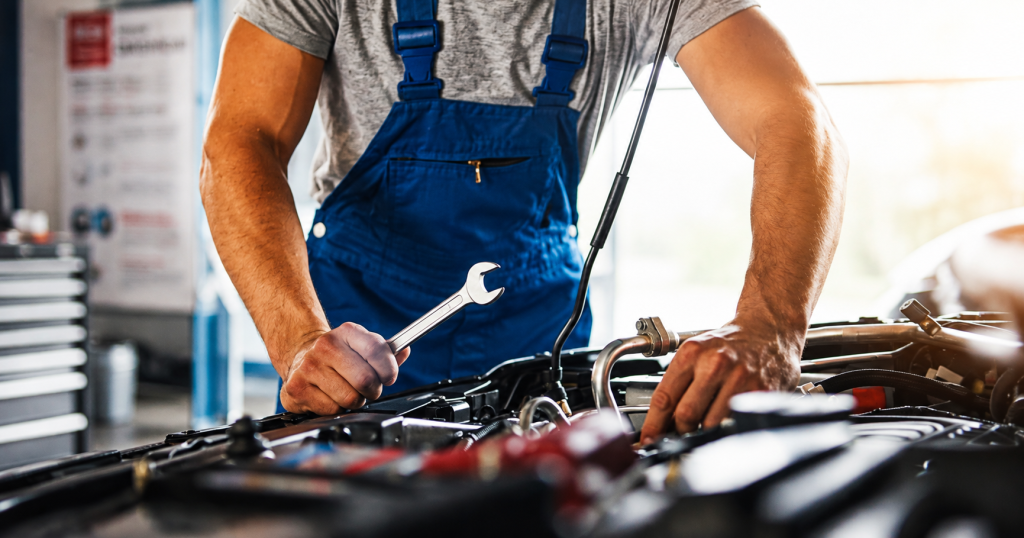
The car maintenance tips that matter in Dubai are not the ones in your handbook. Heat, dust and short stop-start journeys age a car faster than mileage does, which means shorter service intervals, more frequent filter changes, and a few checks that drivers in cooler countries never need to think about.
At Dubai Auto Repair, almost everything we get called out to was preventable, and usually by something that takes ten minutes. The battery that stranded someone in October had been cranking slowly since August.
Here are the ten things worth doing, in rough order of how much difference they make, plus a seasonal calendar for when to do each one.
Key takeaways
- Shade is the single most valuable thing you can give a car here, and it costs nothing
- Tyres over five years old fail the RTA test regardless of how much tread they have
- Filters and oil need replacing more often than the manual assumes, because of dust and heat
- Spring is the right time for AC and cooling system work, not July
- Most breakdowns give warning signs days before they strand anyone
Why Dubai is harder on cars than almost anywhere
Three conditions stack here in a way they rarely do elsewhere.
Sustained heat, with ambient temperatures above 45°C for months and road surfaces reaching 70°C or more. Fine dust that gets into filters, condensers and paint. And traffic patterns built around short trips with long idles.
Individually each is manageable. Together they mean a three-year-old car here has aged like a five-year-old car in a temperate climate, and your maintenance schedule should reflect that rather than the manual’s assumptions.
1. Park in shade whenever you possibly can
This is the highest-value habit on the list and the only free one.
Under-bonnet temperature is the biggest factor in battery life, rubber seal degradation, oil oxidation and dashboard cracking. A car parked in a basement rather than an open lot experiences a meaningfully different life.
When you cannot park in shade, use a windscreen sunshade. It costs almost nothing and drops cabin temperature enough to reduce the load on your AC every time you start the car.
2. Shorten your oil change interval
Most manufacturers publish a normal schedule and a severe one, and Dubai driving meets the severe definition on four counts at once: extreme heat, dust, stop-and-go traffic and short trips.
In practice that means cutting the manual’s interval by roughly a third. We have set out how often to change car oil in the UAE and why short journeys are harder on oil than motorway miles, which is the part that surprises most drivers.
3. Test the battery once it passes two years
Batteries here last two to three years, not the four to five quoted elsewhere. Heat damage is permanent and cumulative, and it accrues silently.
The awkward part is the timing. Batteries usually fail on a cool morning in October, not during the heat that killed them, so a battery that got you through summer is not a battery that will get you through autumn.
Test it annually once it passes two years old, and learn to read the manufacture date code stamped on the case. We explain both in our guide to car battery life in Dubai heat.
4. Check tyre pressure cold, every two weeks
Tyre pressure rises roughly 1 PSI for every 5°C increase in temperature. Check pressures in the morning before driving, when the tyres are cold, because a reading taken after a motorway run will be misleadingly high.
Use the figure on the placard inside the driver’s door frame, not the number moulded into the tyre sidewall. That sidewall figure is a maximum, not a recommendation, and inflating to it is how people create blowout risk.
Both under and over-inflation matter here. Underinflated tyres flex and build heat, overinflated ones have less contact patch and are more prone to bursting on hot asphalt.
5. Check your tyre age, not just the tread
This one catches out almost everybody, because it has nothing to do with how the tyre looks.
Tyres in the UAE must be no more than five years old from the date of manufacture. A vehicle will not pass its technical test on expired tyres even with plenty of tread remaining, and the RTA covers the testing and renewal requirements in full.
Finding the age takes ten seconds. Look for the DOT code on the sidewall, ending in four digits. A code ending 1524 means week 15 of 2024.
Worth knowing: worn tyres carry a AED 500 fine under Article 82 of the federal traffic law, along with black points and possible impoundment. Heat degrades rubber whether you drive on it or not, which is why a low-mileage car can still need new tyres.
6. Service the AC in spring, not in July
Every workshop in Dubai is busy with AC work from June onwards, and every one of those cars showed early signs months before.
Get the system checked in March or April. A weak compressor or a slow leak found in spring is a manageable repair. The same fault found in August is an emergency with a queue in front of it.
One thing worth knowing: a gas top-up without a leak test is money you will spend again in a few months. Our guide to why car AC stops cooling in Dubai covers the six real causes and how to tell which one you have.
7. Replace air and cabin filters more often than the manual says
Manufacturer filter intervals assume European or American dust levels. Dubai supplies considerably more.
A clogged air filter restricts airflow to the engine and costs you fuel economy and power. A clogged cabin filter reduces how much cold air actually reaches you, which people frequently mistake for an AC fault.
Both are cheap and quick. Check them at every service rather than waiting for the scheduled replacement, and replace them when they look dirty rather than when the odometer says so.
8. Check coolant and hoses before summer starts
Overheating is the classic Dubai breakdown, and the cooling system gives warning first.
Check the coolant level in the expansion tank when the engine is cold. Look at the colour, because rust-coloured or oily coolant signals a problem beyond a top-up.
Squeeze the radiator hoses. They should feel firm but pliable. Rock-hard or spongy hoses are heat-aged and due for replacement before they split at the worst moment.
And check the cooling fan actually runs. Sit with the engine idling and the AC on, and listen for it cutting in. A fan that has quietly failed only shows up when you are stationary in traffic on a hot day.
9. Wash the car properly, including the front grille
Dust is not just cosmetic here. Fine sand packs into the condenser fins behind the grille and blocks heat transfer, which weakens your AC and pushes engine temperatures up.
A gentle rinse through the grille as part of a regular wash slows that build-up. It will not clear a condenser that is already packed, but it delays getting there.
On the paint, avoid wiping a dusty car with a dry cloth. Desert sand is abrasive, and dry-wiping is how cars here acquire fine swirl marks across every horizontal panel.
10. Keep a proper summer emergency kit
A warning triangle is mandatory equipment and gets checked at inspection. Beyond that, carry at least two litres of drinking water, a reflective jacket, a power bank and a torch.
Breaking down in January is inconvenient. Breaking down in July with nothing in the car is a genuine risk, and heat exhaustion arrives faster than most people expect on open tarmac.
Knowing the procedure matters as much as the kit. We have set out exactly what to do if your car breaks down in Dubai, including the fine for stopping in a live lane and why getting off the carriageway while still rolling is the most important thing you can do.
A seasonal maintenance calendar for Dubai
Most maintenance advice tells you what to do without telling you when. Here is the version that fits the climate.
| When | What to do |
|---|---|
| Every two weeks | Tyre pressures, cold, all four plus the spare |
| Monthly | Oil level, coolant level, lights, wiper condition |
| March to April | AC service, coolant and hose check, cooling fan test, battery test |
| Every service | Air and cabin filters, brake inspection, tyre wear pattern |
| September to October | Battery test again, AC check after the heat, tyre inspection |
| Annually | Full service, tyre age check, RTA test if the car is over three years old |
The two battery tests are deliberate. One before summer to catch a battery that will not survive it, one after to catch the damage the summer did.
What this costs, and what skipping it costs
Preventive maintenance in Dubai runs a few hundred dirhams a year beyond your normal servicing. Filters, a coolant check, an AC inspection and a battery test.
Against that, a seized engine from ignored overheating, a AED 3,000 compressor from a leak nobody chased, or a recovery truck on a Friday night. Our breakdown of car service costs across Dubai puts numbers against both sides.
The arithmetic is not subtle. Almost every expensive repair we do started as a cheap one somebody deferred.
Frequently asked questions
How often should I service my car in Dubai?
Follow the severe service schedule in your manual, or shorten the normal interval by about a third. For most cars that means a minor service every six to nine months rather than annually.
What is the most important car maintenance in Dubai heat?
Cooling and electrical. That means the AC and engine cooling systems, the battery, and the oil. Those four account for the large majority of heat-related failures here.
How do I protect my car from the sun in Dubai?
Park in shade or covered parking whenever possible, use a windscreen sunshade, and wash regularly to remove abrasive dust. Those three slow interior cracking, seal degradation and paint damage more than any product you can buy.
How often should I check tyre pressure in the UAE?
Every two weeks, in the morning before driving. Pressure changes with temperature, so a cold reading against the door placard figure is the only meaningful one.
Do tyres really expire in the UAE?
Yes. Tyres over five years old from the manufacture date fail the RTA technical test regardless of tread depth, because heat degrades the rubber whether the car is driven or parked.
When should I check my AC before summer?
March or April. Faults found before the heat arrives are cheaper, and workshops are not yet running an AC backlog.
The short version
Park in shade. Shorten your oil interval. Test the battery twice a year. Check tyre pressures cold and tyre age annually. Sort the AC and cooling system in spring.
That is most of it. None of it is complicated, and all of it is cheaper than the alternative.
We do servicing, diagnostics and preventive checks wherever your car is parked across Dubai, so none of this needs to cost you a morning at a workshop. Our annual service contracts cover the scheduled work if you would rather have one fixed yearly figure.
Get in touch and we will come to you.

