
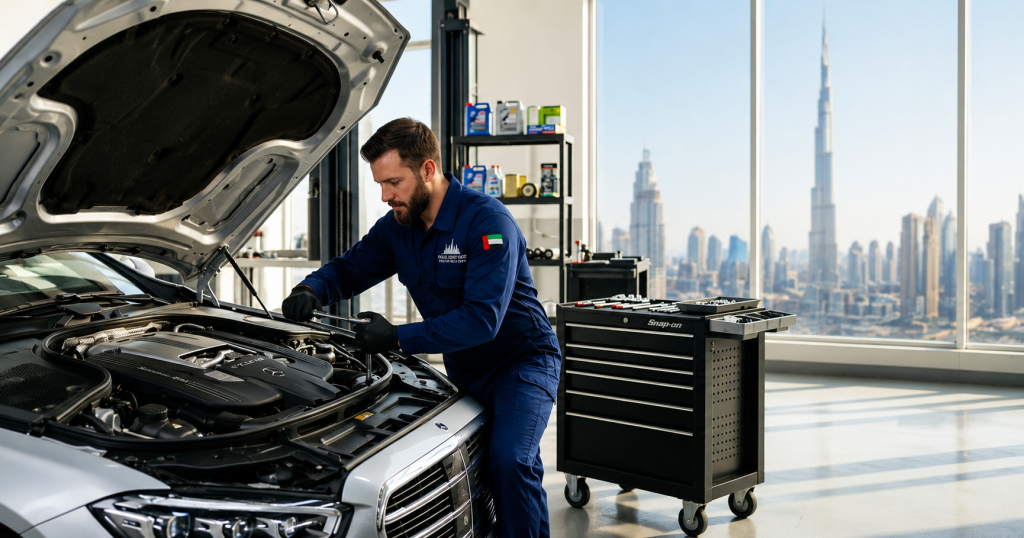
The most useful used car checklist in Dubai starts with paperwork, not the car. Check for an outstanding bank mortgage, unpaid fines and the RTA vehicle history before you inspect a single panel, because those three can cost you the entire purchase price no matter how good the car turns out to be.
At Dubai Auto Repair, we inspect cars for buyers, and the pattern repeats. People spend forty minutes looking at paint and thirty seconds looking at documents. The paint rarely costs anyone AED 95,000. An undisclosed bank loan can.
This guide covers the document checks specific to buying here, what to look for on the car itself, the heat damage that catches out buyers from cooler countries, and the checks you cannot realistically do on your own.
Key takeaways
- A car with an unreleased bank mortgage cannot be transferred to you, and the bank can reclaim it even after you pay
- Unpaid fines block the transfer, so they must be cleared before money changes hands
- The RTA vehicle history report shows a year-by-year mileage trail, which is the simplest way to spot a wound-back odometer
- Dubai heat damages rubber, plastic and paint in ways that reveal how a car was stored
- Never hand over payment before the lien is cleared and the transfer completes
Start with the paperwork
Three document checks matter more than anything you will find with a torch.
Outstanding bank finance
This is the expensive one. If the seller financed the car and has not settled the loan, the bank holds a lien on it. The RTA will not transfer ownership until the bank issues a release.
Worse, if you pay a seller and take the car without the transfer completing, the bank can legally reclaim the vehicle. You are then chasing a private individual for your money.
Ask for a clear photo of both sides of the Mulkiya, the vehicle registration card. A bank name in the owner section means active finance. If the seller is reluctant to send it, that reluctance is your answer.
Never take possession or hand over payment before the lien is formally released and the transfer completes. Those two steps should happen in the same transaction window, not on a promise.
Unpaid traffic fines
Fines attach to the vehicle. The RTA will not process a transfer while they are outstanding, so this becomes your problem in practice even though it was not your driving.
Check the plate number through the Dubai Police fines service or the RTA app before you view the car. It takes two minutes and eliminates some listings on the spot.
The RTA test status
Vehicles over three years old need to pass an RTA technical test before the registration can be renewed or the ownership transferred, and the passing certificate has a limited validity window. The RTA sets out the renewal and testing requirements, and it is worth confirming the current position there rather than taking the seller’s word for it.
Ask when the car last passed and whether it failed anything first. A car that failed on tyres and passed on the retest tells you tyres were replaced. A car that failed on brakes tells you more.
The vehicle history report, and the one line worth paying for
Dubai’s RTA issues a technical vehicle status report covering ownership history, insurance record, test and inspection results, outstanding fines, and whether the car has been used commercially.
Commercial use matters. A former taxi or rental car has done harder kilometres than the odometer suggests, and that shows up in clutch, suspension and interior wear well before it shows in the service history.
But the single most useful part is the mileage trail. The RTA records the odometer reading at every annual registration renewal, which produces a year-by-year record.
A genuine car shows a steady climb. A car whose reading jumped 30,000 km one year and 4,000 km the next, or whose current reading sits below a previous entry, has a problem. This is the cleanest odometer check available anywhere, and most buyers never look at it.
What to check on the car itself
Heat and sun damage
This section is where Dubai differs from every used car guide written elsewhere.
Look at the dashboard top for cracking or warping. Check the rubber door and window seals for hardening, shrinking or splitting. Look at the roof, bonnet and boot lid for paint that has gone flat, chalky or faded compared with the vertical panels.
All three tell you the same story: this car lived outside. That is not automatically a dealbreaker, but it means every rubber, plastic and electronic component has aged faster than the mileage implies.
Check the headlight lenses too. Heavy yellowing and hazing is another outdoor-parking marker, and it fails visibility checks.
Signs of accident repair
Open the bonnet and boot and look at the bolt heads on the wings, bonnet hinges and boot hinges. Factory bolts have untouched paint on them. Spanner marks mean panels came off.
Run your eye down each side of the car from the front and rear corners. Panel gaps should be even and consistent. A door gap wider at the top than the bottom is not how the car left the factory.
Check for overspray on rubber seals, plastic trim and inside the door shuts. Look for paint texture that differs between adjacent panels under strong light.
Accident repair is common and not always a problem. Undisclosed structural repair is a different matter, and it is one of the main things a professional inspection is looking for.
Under the bonnet
Pull the dipstick. Amber and translucent is healthy. Black, gritty or burnt-smelling oil suggests a car that was not serviced on schedule, which matters more in this climate than in most.
Check the coolant level and look at the expansion tank. Rust-coloured or oily coolant is a warning sign. Squeeze the radiator hoses when cold, and treat rock-hard or spongy hoses as due for replacement.
Look at the battery. There is a manufacture date code stamped on it, and reading it takes ten seconds. Given that batteries last only two to three years in Dubai heat, a battery already past two years is a cost you will be picking up shortly.
Tyres and brakes
Check all four tyres including the spare. Look at the DOT date code on the sidewall, because tyres degrade with age here even without mileage, and a five-year-old tyre with plenty of tread is still an old tyre.
Uneven wear across the tread points to alignment or suspension problems. Wear on the inner edge only is a common one and usually means worn suspension components.
Look through the wheels at the brake discs. A pronounced lip at the outer edge means they are near the end of their life.
The AC test, done properly
In Dubai this is not a convenience feature. It is one of the more expensive things to put right, and it is easy to test badly.
Start the engine, set the AC to maximum, and let it run for at least ten minutes. Anyone rushing you past this step is doing so for a reason.
Then do the thing most buyers skip: leave the car idling and stationary for several minutes with the AC on. Cooling that fades when the car is not moving points to a weak cooling fan or a dust-blocked condenser, and that fault only appears when stationary. We covered the six real causes of weak AC in Dubai and what each one costs to fix.
Listen for the compressor clutch engaging, and check airflow strength from every vent, not just the driver’s side.
The test drive
Drive it cold if you can. A seller who has warmed the car up before you arrive may be hiding a cold-start rattle or a puff of smoke.
Find a quiet stretch and briefly let go of the wheel at low speed. The car should track straight. Pulling to one side means alignment or suspension.
Brake firmly from a reasonable speed. Vibration through the pedal means warped discs. Pulling to one side means a sticking caliper.
Go over a few speed bumps slowly with the windows down and listen. Knocks and clunks are suspension, and Dubai’s speed bumps are hard on suspension components.
On an automatic, feel for hesitation, jerking or slipping between gears. On the motorway, check it holds top gear without hunting.
What you cannot check yourself
An honest checklist has to include its own limits.
You cannot read stored fault codes without a scan tool, and a cleared code memory looks identical to a healthy one for a few days. You cannot see the underside without a lift. You cannot measure paint thickness to detect filler by eye. And you cannot test a battery’s actual capacity without a load tester.
That is the gap a professional pre-purchase inspection fills. Someone brings the diagnostic equipment to wherever the car is parked, runs the scan, checks the things a torch cannot reach, and hands you the findings before you commit.
On a purchase running into tens of thousands of dirhams, an inspection costs a rounding error. It also gives you something concrete to negotiate with, which frequently pays for itself several times over. Our pre-purchase inspection service comes to the car rather than asking you to arrange for it to be driven anywhere.
Red flags worth walking away from
- The seller will not show both sides of the Mulkiya
- The name on the Mulkiya does not match the person selling the car
- A bank name appears in the owner section and the seller is vague about clearing it
- Pressure to pay a deposit before you have run any checks
- Refusal to allow an independent inspection
- No service history at all on a car under six years old
- A chassis number that does not match the Mulkiya
- Milky residue under the oil cap, which suggests coolant in the oil
Any one of these is enough to move on. There are a lot of used cars in Dubai, and the expat turnover means another one arrives every week.
Budgeting for what comes after
One habit worth building: price the car including its next six months.
Tyres near the wear bars, a battery past two years, brake discs with a lip and an AC that cools weakly are not reasons to walk away. They are reasons to adjust your offer, because you will be paying for all four fairly soon.
Our guide to car service costs across Dubai gives you the numbers to put against each of those, which turns a vague sense that the car needs work into a specific figure you can negotiate with.
Frequently asked questions
What should I check when buying a used car in Dubai?
Check the paperwork first: no outstanding bank mortgage, no unpaid fines, valid registration, and a clean RTA vehicle history. Then inspect the car for accident repair, heat damage, tyre and brake wear, and test the AC thoroughly.
How do I check if a used car has a bank loan in Dubai?
Ask for clear photos of both sides of the Mulkiya, where a bank name in the owner section indicates active finance. You can also check vehicle status through the RTA app and the Emirates Vehicle Gate platform.
Do unpaid fines transfer to me when I buy a car?
Fines attach to the vehicle and the RTA will not complete a transfer while they are outstanding, so they must be cleared before the sale goes through. Check the plate number before you view the car.
Can I check a used car’s real mileage in Dubai?
Yes. The RTA records the odometer at each annual registration renewal, so the vehicle history report gives a year-by-year mileage trail. Irregular jumps or a reading lower than a previous entry indicate tampering.
Is a pre-purchase inspection worth it in Dubai?
On any car worth more than a few thousand dirhams, yes. A scan tool and a proper underside check find things no visual inspection can, and the findings usually give you enough to negotiate more than the inspection cost.
What is the most common thing buyers miss?
Heat damage. Buyers from cooler countries look at mileage and service history but not at hardened rubber seals, a cracked dashboard or faded horizontal panels, all of which show the car lived outside and aged faster than the odometer suggests.
Before you pay
Get the documents right, then get the car looked at, then negotiate on what you find.
In that order. A beautiful car with a bank lien on it is not a car you own, and no amount of inspecting the paintwork changes that.
We inspect cars for buyers wherever the vehicle is parked, run a full diagnostic scan, and give you the findings before you commit to anything.
Get in touch and we will come to you.

