
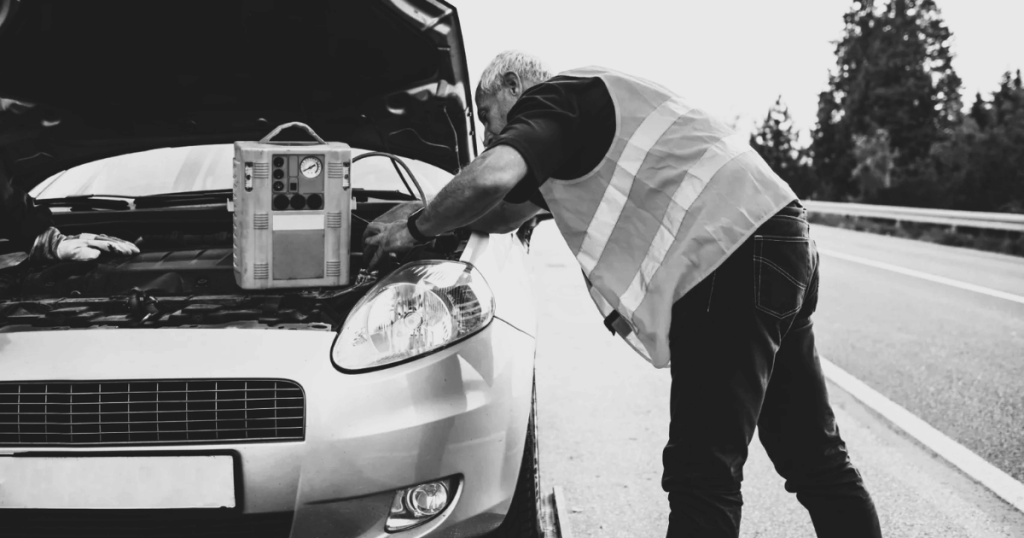
If your car breaks down in Dubai, the order matters: hazard lights on, pull as far left off the carriageway as you can, get everyone out and behind the barrier, place a warning triangle well behind the car, then call for help. Your safety comes first, the car second.
At Dubai Auto Repair, we take breakdown calls at every hour, and the pattern is consistent. Two faults account for most of them, and both give warning signs days before they strand anyone.
This guide covers the exact steps to take, what stopping in a live lane costs you under UAE law, what to do when your car overheats or refuses to start, and how to tell whether you need a tow or just a mechanic.
Key takeaways
- Halting in a traffic lane carries a fine of AED 1,000 and six black points under federal traffic law
- Dubai Police advise getting all occupants out of the vehicle and away from live lanes
- A warning triangle is mandatory equipment and gets checked at vehicle inspection
- Never open the radiator cap on an engine that has overheated
- Most breakdowns here trace back to the battery or the cooling system, and both give warning first
The first sixty seconds
What you do immediately after the car stops matters more than anything that follows. Work through these in order.
- Hazard lights on straight away. Do this before anything else, even before you finish slowing down. On a fast road it is the only warning approaching traffic gets.
- Get off the carriageway. Use whatever momentum you have left. Aim for the hard shoulder, an exit slip, or a side street. A car that coasts fifty metres further off the road is a much safer car.
- Exit from the passenger side. Doors on the traffic side open into moving vehicles. Everyone leaves through the doors furthest from the lanes.
- Move behind the barrier. Dubai Police guidance is clear on this: driver and passengers should leave the vehicle and move to a secure location away from traffic. Do not stand next to the car, and do not stand in front of it.
- Place your warning triangle. At least 45 to 50 metres behind the car, further on a fast road. At 100 km/h drivers need that distance to see you and change lanes.
- Call for help. 999 for emergencies. Dubai Police also operate 901 for non-emergency calls. Give a landmark, an exit number or a live location pin rather than a road name alone.
One exception worth understanding. If you cannot get out safely, because there is no shoulder, no barrier, or traffic is heavy on all sides, stay inside with your seatbelt fastened, keep the hazards on, and call 999 immediately. Standing on a live carriageway is worse than sitting in a stationary car.
In summer, add one more thing. If you are out of the car and waiting, find shade or stay upwind of the vehicle. Waiting thirty minutes on hot tarmac in August is its own hazard.
What getting this wrong actually costs
UAE traffic law treats stopping in a live lane seriously, and for good reason. Dubai Police have repeatedly warned about it after fatal collisions involving stationary vehicles on Emirates Road and similar highways.
Halting a vehicle in a traffic lane carries a fine of AED 1,000 and six black points under federal traffic law. Obstructing traffic draws a further AED 500 from Dubai Police. Those apply even when the stop was not your choice, which is exactly why the first move is to get the car off the carriageway while it is still rolling.
Fines and procedures do change, so check the current position on the Dubai Police portal rather than relying on figures quoted elsewhere.
Worth knowing: the warning triangle is not optional equipment you can skip. It forms part of the check at vehicle inspection, and it is the single cheapest piece of safety kit in your boot. If yours has gone missing, replace it before you need it.
If your car overheats
This is the classic Dubai breakdown, and it peaks between June and September.
The temperature gauge climbing towards red, steam from under the bonnet, or a sudden smell of hot coolant all mean the same thing. Stop as soon as you safely can.
Here is what to do, and one thing never to do.
Switch off the AC and turn the heater on full. This sounds mad in a Dubai summer, and it works. The heater matrix pulls heat out of the coolant, which buys you time to reach somewhere safe.
Pull over and switch the engine off. Continuing to drive an overheating engine warps cylinder heads and blows head gaskets. A tow costs far less than that repair.
Open the bonnet only when it is safe to approach. Releasing trapped heat helps, but not at the cost of a burn.
Never open the radiator or expansion cap. The coolant inside is above boiling point and under pressure. Opening the cap sprays scalding fluid, and this causes serious burns every single summer. Wait until the engine is completely cool, which takes at least thirty minutes and often longer.
Once the engine cools, you might get the car moving again. That does not mean the problem is fixed. Overheating points to a coolant leak, a failed thermostat, a weak water pump or a dead cooling fan, and it will happen again on the next hot run.
If your car will not start
The battery causes more no-starts in Dubai than everything else combined, and the reason is heat rather than age.
The symptoms tell you a lot before anyone opens the bonnet. Rapid clicking with no crank usually means the battery lacks the current to turn the engine. A slow, laboured crank means it is nearly there but not quite. Complete silence with no dashboard lights points to a dead battery or a bad connection.
If the engine cranks strongly but will not fire, the battery is probably fine and you are looking at fuel or ignition instead.
Two things are worth doing before you call anyone. Check that the battery terminals are tight and free of crusty corrosion, because a loose terminal produces exactly the same symptoms as a flat battery. And if the car is an automatic, try starting it in neutral rather than park, which occasionally works around a faulty neutral safety switch.
A jump start gets you moving, but treat it as a diagnosis rather than a cure. If a battery went flat once, it will go flat again unless someone tests the charging system. We have covered why car batteries last only two to three years in Dubai heat and how to check how old yours actually is, which is the check most drivers never do.
What to keep in the car through a Dubai summer
Breaking down in January is inconvenient. Breaking down in July with nothing in the car is genuinely risky.
- Warning triangle, which is mandatory anyway
- At least two litres of drinking water, replaced regularly
- A reflective jacket, which costs almost nothing and makes you visible
- A power bank, because a dead phone in a breakdown is a serious problem
- A torch for night breakdowns and sandstorms
- A sunshade, which drops cabin temperature meaningfully while you wait
- Your insurance and recovery details saved somewhere other than your phone’s browser history
The water matters most. Heat exhaustion sets in faster than people expect when you are standing on tarmac in direct sun.
Do you need a tow, or just a mechanic?
Most drivers assume a breakdown means a tow truck. It often does not, and that assumption costs both money and half a day.
These get fixed where the car sits, in most cases within the hour: flat battery, faulty alternator, blown fuses and relays, loose or corroded terminals, flat tyre, minor coolant leak or top-up, sensor faults, and a good number of electrical no-starts.
These genuinely need recovery to a workshop: a seized or severely overheated engine, a failed water pump or head gasket, gearbox failure, brake failure, and anything where the car is unsafe to drive even short distances.
The honest answer is that you cannot always tell from the driver’s seat, which is why a diagnosis at the roadside is worth doing before anyone books a tow. Our 24/7 roadside assistance exists for exactly this: we arrive with the diagnostic equipment, find out which of the two situations you are actually in, and fix it there if it can be fixed there.
Most Dubai breakdowns give warning first
Looking back at the calls we take, very few are genuine surprises.
The battery cranked slowly for a week. The temperature gauge sat slightly higher than usual on the school run. The AC weakened in traffic before the cooling fan gave up entirely. Somebody noticed, decided it was fine, and got three more weeks out of it.
Two checks prevent most of this. Test the battery once it passes two years old, and check your coolant level and the condition of the hoses before summer starts rather than during it.
Neither takes long. Both are considerably cheaper than a recovery truck and a ruined afternoon.
Frequently asked questions
What should I do if my car breaks down on a Dubai highway?
Switch on hazard lights, move the car off the carriageway if it is still rolling, exit from the passenger side, move behind the barrier away from traffic, place a warning triangle 45 metres or more behind the car, and call 999.
Is there a fine for breaking down on the road in the UAE?
There is no fine for the breakdown itself, but halting in a traffic lane carries AED 1,000 and six black points, with a further AED 500 for obstructing traffic. Getting the vehicle off the carriageway is what avoids it.
Should I stay in the car or get out?
Dubai Police advise leaving the vehicle and moving to a safe location away from live lanes. If you cannot exit safely because there is no shoulder or barrier, stay belted in with hazards on and call 999.
What do I do if my car overheats in Dubai?
Turn the AC off and the heater to full, pull over as soon as it is safe, and switch the engine off. Do not open the radiator cap until the engine has fully cooled, because the coolant is pressurised and will scald.
Who do I call for a car breakdown in Dubai?
Call 999 for emergencies or if you are stopped in a dangerous position. For the repair itself, a mobile mechanic can reach you and often fix the fault on the spot without a tow.
Can a mobile mechanic fix a breakdown at the roadside?
Frequently, yes. Battery, alternator, electrical, fuse, tyre and minor cooling faults all get resolved where the car sits. Engine, gearbox and head gasket failures need recovery to a workshop.
When you are stuck
The car is replaceable and the repair can wait. Getting yourself and your passengers away from moving traffic cannot.
Do that first, put the triangle out, then worry about what went wrong. Once everyone is safe, most faults turn out to be smaller than they felt at the moment the engine died.
We answer breakdown calls around the clock anywhere in Dubai, arrive with the diagnostic equipment, and tell you honestly whether it is a roadside fix or a recovery job.
Get in touch and we will come to you.

