
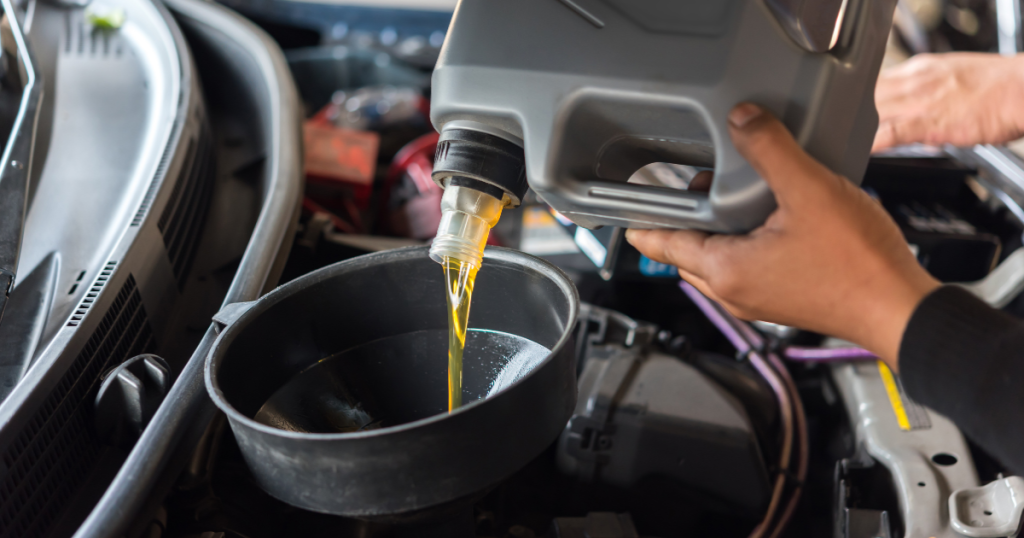
How often to change car oil in the UAE depends less on your mileage than on your conditions. Most manufacturers publish two schedules, a normal one and a severe one, and almost every Dubai driver qualifies for the severe schedule without knowing it. In practice that means cutting the interval in your manual by roughly a third.
At Dubai Auto Repair, we see the result of this often enough that it has become predictable. A car with 40,000 km on the clock, serviced exactly on the manual’s schedule, with oil that looks and smells like it gave up 3,000 km ago.
This guide explains why UAE driving counts as severe service, what heat actually does to engine oil, the interval that works here, and how to check you got the oil you paid for.
Key takeaways
- UAE driving meets four of the standard severe service conditions at once
- Every 10°C rise in oil temperature roughly doubles the rate at which oil oxidises
- Short city trips are worse for oil than long motorway drives, regardless of distance
- Full synthetic handles heat better than mineral oil and is worth the difference here
- The specification on the bottle matters more than the brand on the label
Your manual assumes conditions you do not drive in
Open your owner’s manual to the maintenance section and you will usually find two columns. One says normal. One says severe.
Most drivers read the normal column, because nobody thinks of their daily commute as severe. The word sounds like off-roading or towing a caravan across a desert.
It does not mean that. Manufacturers define severe service by specific conditions, and the list is consistent across almost every brand:
- Frequent trips under about 8 km
- Stop-and-go traffic and extended idling
- Sustained extreme ambient temperatures
- Dusty operating environments
- Towing or carrying heavy loads
Read that list again with a Dubai commute in mind.
Why UAE driving counts as severe service
Most cars here tick four of those boxes on the same journey.
Extreme heat. Ambient temperatures above 45°C for months, with under-bonnet temperatures far higher. Oil that would run at a comfortable temperature in a European summer runs hot here every single day.
Dust. Fine desert sand gets past air filters faster than the manufacturer’s replacement interval assumes. Once abrasive particles reach the oil, the oil stops purely lubricating and starts acting a little like a grinding paste.
Stop-and-go traffic. Sheikh Zayed Road at 8am is thermal stress with no cooling airflow. The engine works, the oil heats, and the car barely moves.
Short trips. This one surprises people the most. A ten-minute drive to the office in a well-cooled car may never get the oil hot enough to do its job properly.
Engine oil needs to reach roughly 100°C before moisture and unburnt fuel evaporate out of it. On a short trip it never gets there, so the water and fuel stay in the sump, mix with the oil, and gradually turn it into something closer to sludge.
A driver doing 5,000 km a year in ten-minute city hops is harder on oil than one doing 20,000 km on motorways.
What heat actually does to engine oil
Oil degrades through oxidation, and oxidation is a chemical reaction. Like most chemical reactions, it speeds up with temperature.
The working rule in the lubrication industry: every 10°C rise in oil temperature roughly doubles the rate of oxidation. That is the same shape of curve that shortens battery life here, which is why we wrote separately about how long car batteries actually last in Dubai heat. Heat does not damage things gently. It halves and doubles.
Three things happen as oil oxidises.
The additives deplete first. Detergents, dispersants and anti-wear additives are consumed, and they are the part of the oil actually protecting your engine. The base oil is still there. The protection is not.
Viscosity shifts. Oil either thickens as oxidation products build up, or thins under sustained heat, and neither state does the job the engine was designed around.
Deposits form. Oxidised oil leaves varnish and sludge on internal surfaces, which restricts oil flow through narrow passages. On a turbocharged engine those passages include the turbo bearing feed, and a blocked one ends in a repair bill that dwarfs any oil change.
So how often should you change your oil in the UAE?
Start with your manual, not with a rule of thumb from the internet. Modern engines vary enormously in oil capacity, operating temperature and specification.
Then apply the severe schedule. If your manual publishes one, use it. If it does not, cut the normal interval by about a third.
In practice that lands most cars here in these ranges:
| Situation | Practical interval |
|---|---|
| Full synthetic, mostly motorway driving | 8,000 to 10,000 km or 12 months |
| Full synthetic, typical Dubai city driving | 6,000 to 8,000 km or 6 to 9 months |
| Semi-synthetic | 5,000 km or 6 months |
| Mineral oil | 5,000 km or 6 months maximum |
Whichever comes first. That phrase carries more weight here than most drivers realise, because oil ages on a calendar as well as an odometer. A car that covers 3,000 km in a year still needs its oil changed once a year, and if those 3,000 km were short trips, arguably sooner.
If your car has an oil life monitor, use it. Post-2010 vehicles with one track actual operating conditions rather than a generic schedule, so they already account for heat and short trips. Change when it reads 5 to 10 percent remaining, or at twelve months.
Synthetic or mineral oil in UAE heat?
Full synthetic, for almost every car here, and the reason is specifically about heat.
Synthetic base oils are engineered with uniform molecular structure, which gives them better thermal stability, more resistance to oxidation, and more consistent viscosity across a temperature range. Mineral oil, refined from crude, breaks down faster under sustained high temperature.
In a mild climate that difference is real but modest. In a climate where your oil runs hot for eight months a year, it decides whether the oil reaches its interval or gives up halfway.
Semi-synthetic sits in between and suits older, higher-mileage engines with a shorter interval.
One caution worth repeating: some engines specify mineral or a particular viscosity for a reason, and older high-mileage engines sometimes run better on thicker oil. Match the specification rather than assuming more expensive means more suitable.
How to check you got the oil you paid for
Here is a practical habit worth building, and almost nobody does it.
Before the work starts, ask to see the bottle. Then look at two things on the label.
The viscosity grade. Printed as something like 0W-20, 5W-30 or 5W-40. Your car specifies one, and it is usually printed on the oil filler cap or in the manual. They should match.
The API symbol. Licensed oils carry the API service symbol, a round “donut” on the back of the bottle showing the service category, such as API SP or API SQ, and the viscosity grade. The American Petroleum Institute licenses these marks, and their presence tells you the oil was independently verified against a defined standard rather than simply labelled.
European cars often carry an additional manufacturer approval, printed as something like BMW Longlife-04 or MB 229.5. If your car requires one, an oil that meets API standards but not that approval is still the wrong oil.
Bulk oil poured from an unmarked drum tells you nothing. It might be excellent. You have no way to know, and your engine is the thing testing it.
Signs your oil is overdue
The dipstick tells you plenty if you check it occasionally.
Fresh oil is amber and translucent. Oil at the end of its life is dark and opaque, and if it feels gritty between your fingers it has been carrying dust for a while.
A burnt smell means the oil has been running too hot for too long. A milky or creamy appearance points to coolant getting in, which is a separate and more urgent problem than an oil change.
Beyond the dipstick: louder engine noise at idle, the oil pressure light flickering on start-up, or the oil level dropping between services. Modern engines consume some oil, but a noticeable drop is worth investigating rather than simply topping up.
Why we do oil changes at your location
An oil change takes under an hour and needs no lift for most cars. Driving to a workshop, waiting, and driving back takes half a morning.
We bring the oil, the correct filter for your vehicle, and a proper disposal container to wherever your car is parked. You see the bottle before it goes in, and you get the old oil taken away rather than left as your problem.
Our oil change and minor service covers the oil, oil filter, fluid top-ups and a visual inspection of brakes, tyres and belts, which is the point at which small problems are cheapest to catch.
Frequently asked questions
How often should I change my car oil in the UAE?
Follow the severe service schedule in your manual, or cut the normal interval by about a third. For most cars here that means 5,000 to 8,000 km or every six to nine months, whichever comes first.
Does heat really shorten engine oil life?
Yes, substantially. Every 10°C rise in oil temperature roughly doubles the rate of oxidation, which depletes the additives that protect your engine well before the oil looks used.
Is synthetic oil worth it in Dubai?
For most cars, yes. Synthetic resists thermal breakdown far better than mineral oil, and sustained heat is exactly the condition where that advantage shows up.
Can I go 10,000 km between oil changes in the UAE?
Only if you are running full synthetic and your driving is mostly longer motorway runs. Short city trips in traffic degrade oil faster than the odometer suggests, and that combination should be shorter.
What oil grade does my car need?
Check the oil filler cap or the manual. It will specify a viscosity such as 5W-30 and often a manufacturer approval as well. Match both, and treat brand as the last consideration rather than the first.
How do I know if my oil needs changing?
Check the dipstick. Dark, opaque, gritty or burnt-smelling oil is overdue. Milky oil signals coolant contamination and needs looking at straight away rather than at the next service.
Getting the interval right
Oil is the cheapest maintenance you will ever do and the most expensive to skip. A worn engine costs thousands. An oil change does not.
Work out honestly whether your driving is normal or severe. If you sit in traffic, do short trips, or park outside in August, you already know the answer.
Then use the right oil, at the right interval, and check the bottle before it goes in.
Get in touch and we will come to you.

